Home/Professional
Medical simulation, manufacturing, AI and automation. They may not seem to have much in common, but I often let curiosity lead and my interdisciplinary mindset fills in the gaps.
Overview
My career doesn't follow a conventional path. Medical simulation, manufacturing, AI and automation: on paper they may not have much in common. They are bound by a specific mindset: recognize a need, understand why and how it's needed, and build something that performs.
Over 15 years of following my curiosity has allowed me to produce a U.S. patent, dozens of products used by surgeons and the military, a manufacturing record that raises some eyebrows, and a growing set of AI and automation skills that are evolving as quickly as the space itself.
This is how I got here.
Medical Simulation R&D
Designing surgical training devices from scratch: head models, skin suits, sclerotherapy pads, a U.S. patent. 2011–2022.
Industrial Manufacturing
Level 3 operator in 8 months. Built an internal app under my own initiative that's currently under company review.
AI & Automation
Started as a way to be more time efficient with Make, Zapier, and API calls. Quickly evolved into a passion hosting open-source models, creating protocols, and vibe coding almost everything.
2011 – 2022
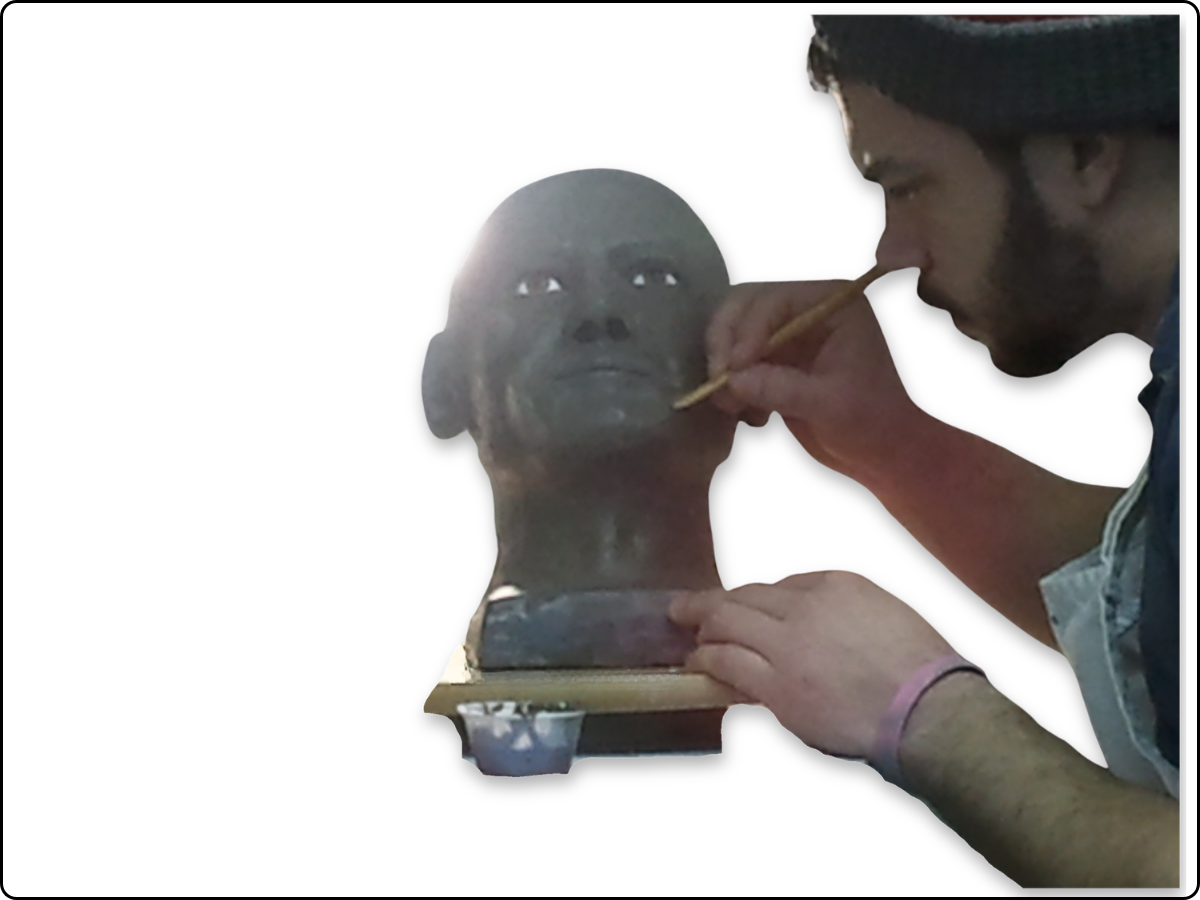
I started at a small medical simulation company in Ohio. After three months of building the models, the founder recognized I understood the process well and gave me some informal training before I moved with the company up to Chicago.
If you've been a startup founder or part of one at its beginning, you can understand the passion it takes. I would often stay at the office for long stretches because my commute was 3.5 hours round trip. With the amount of work to be done, it just made sense not to leave. Once, that meant staying for two weeks straight, but I emphasize this again: passion.
During those days, the ideas just kept coming. This is when I found my rhythm and started making some great products.
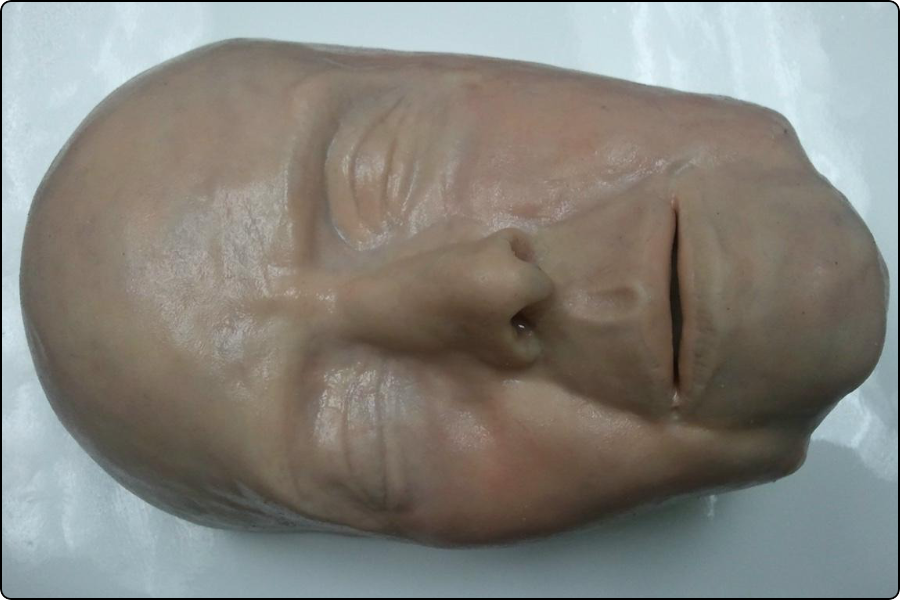
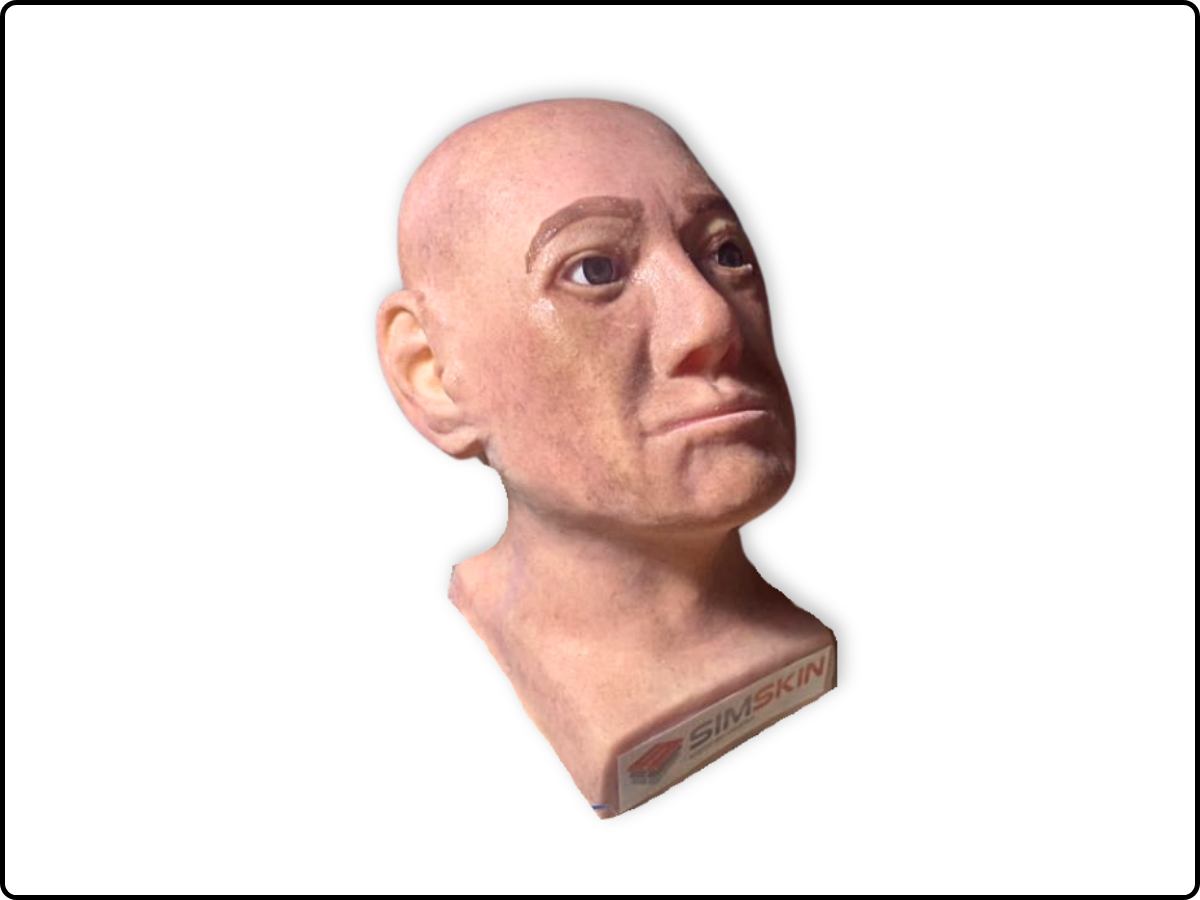
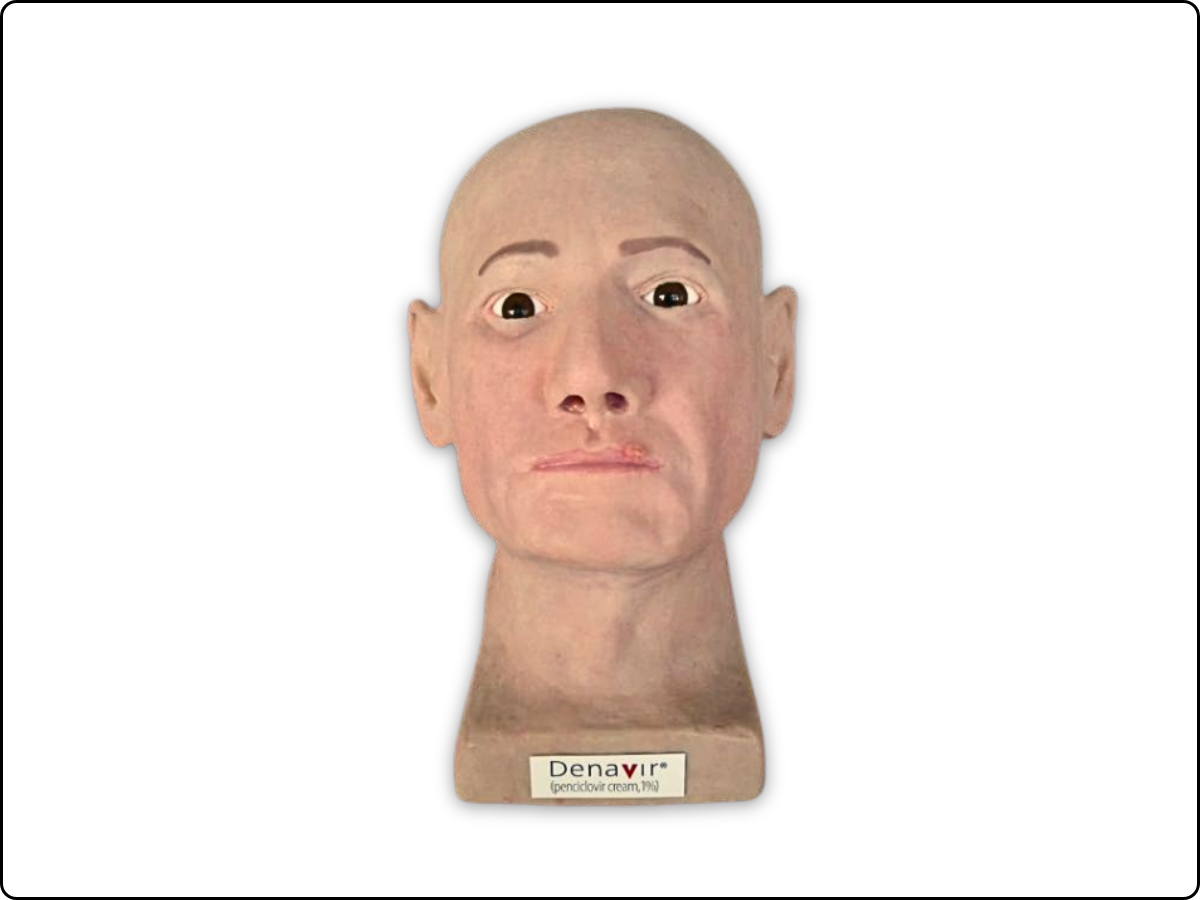
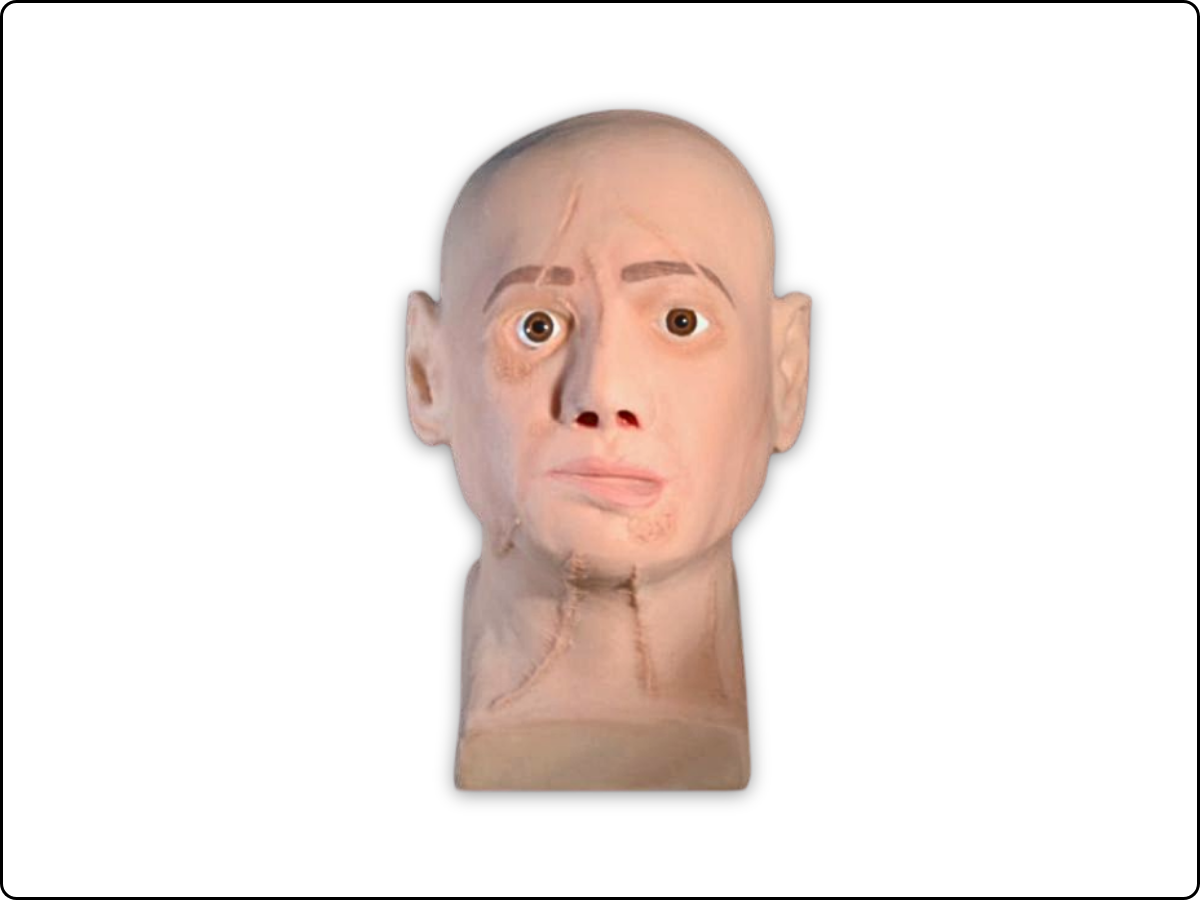
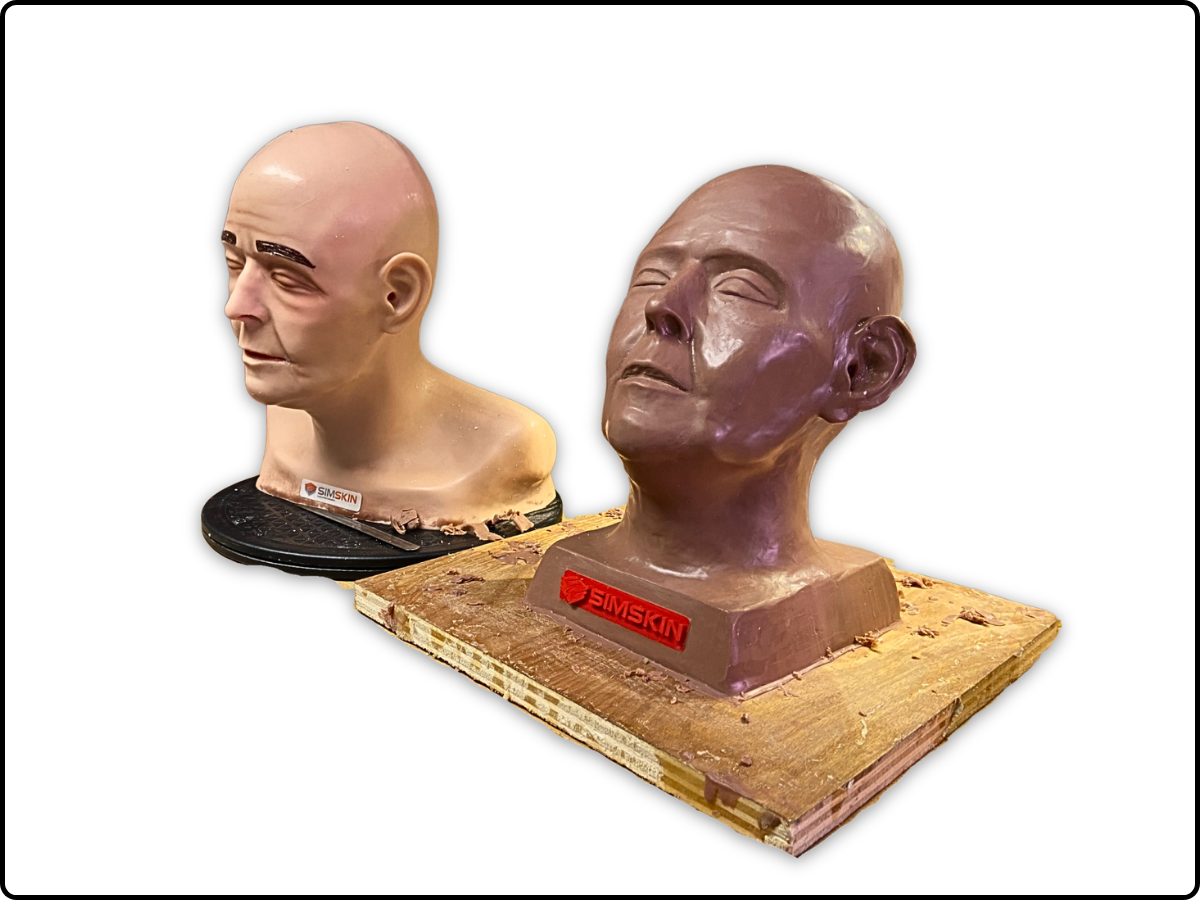
Head model for filler injection training
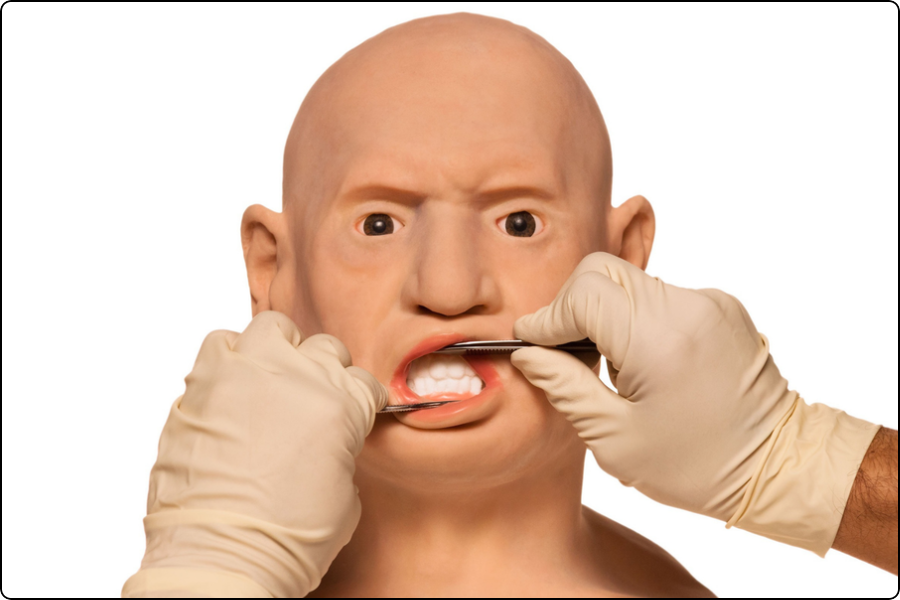
Duomo head model, open mouth demonstration
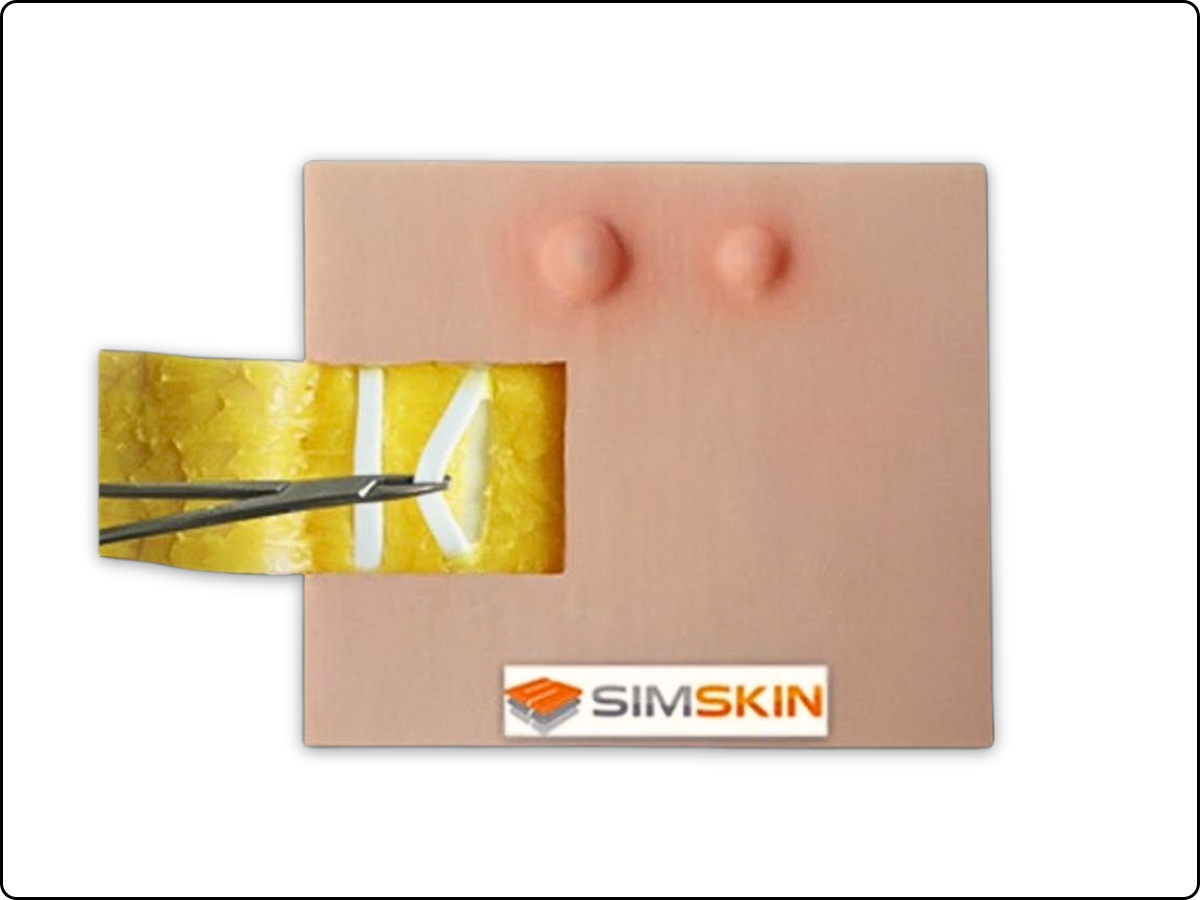
My first big success came from a design I made for Ethicon. They wanted a custom skin pad their sales reps could carry to demonstrations. I designed a translucent pad with layered dermis and subcutaneous anatomy, and their logo embedded underneath the skin layer, visible through the material. This allowed the rep to show how the suture operated while under the skin. It became the largest contract the company had landed to that point and would eventually have knockoffs being made overseas. I found that to be flattering to be honest.
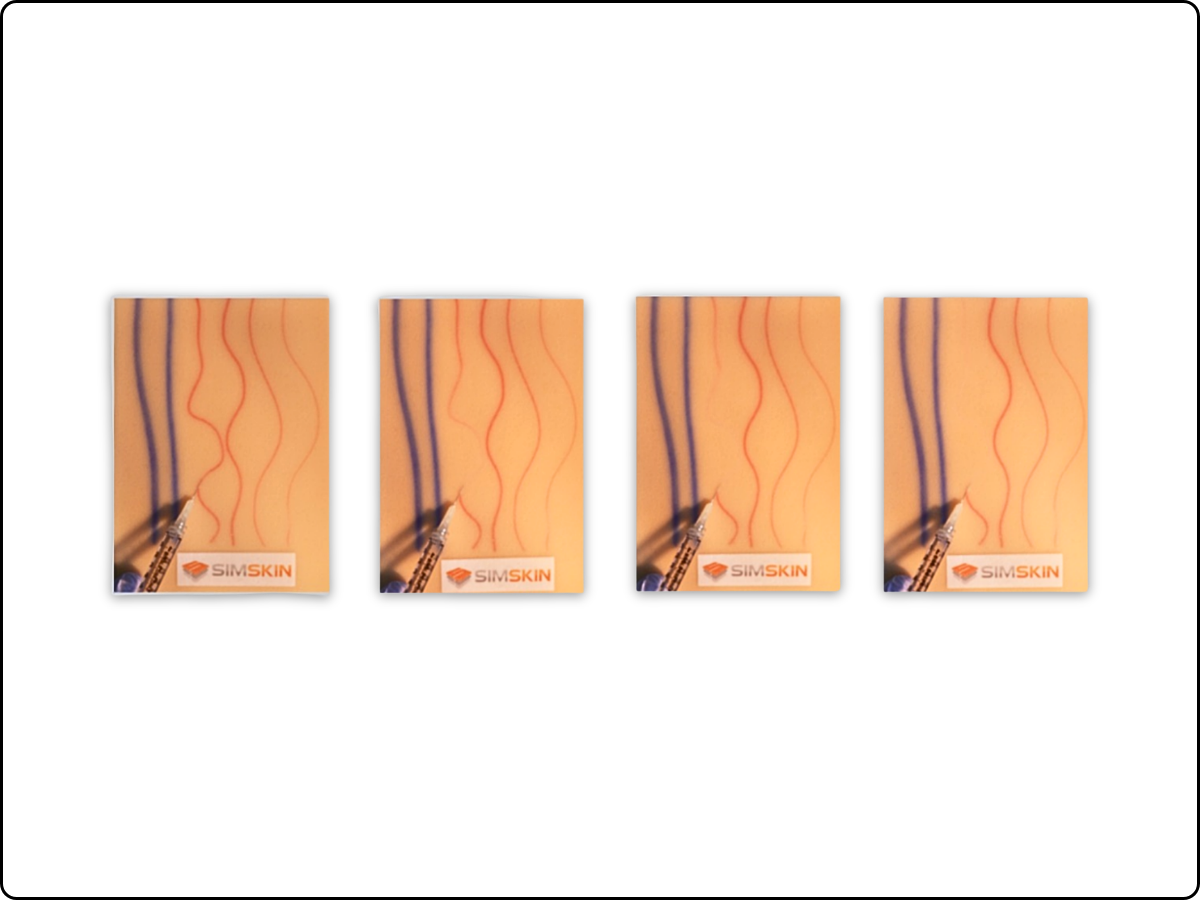
The sclerotherapy pad is the project I'm most proud of. The founder had handed this project over to me unsolved. The procedure involves injecting a sclerosing agent into varicose veins, causing them to collapse and disappear. Simulating that visually was a puzzle that went unsolved.
I remembered a mood ring I'd had as a kid and I researched how it worked. I looked up thermochromic pigments, mixed them into silicone, and made hollow vessels with it. When you injected warm liquid, the vessels appeared to vanish, exactly like the real procedure. The medical advisors were thrilled. It was fully reusable: cool it down and it reset completely. Nothing else on the market did what it did, and still does.
Live injection demonstration. Vessels vanish on contact with warm fluid.
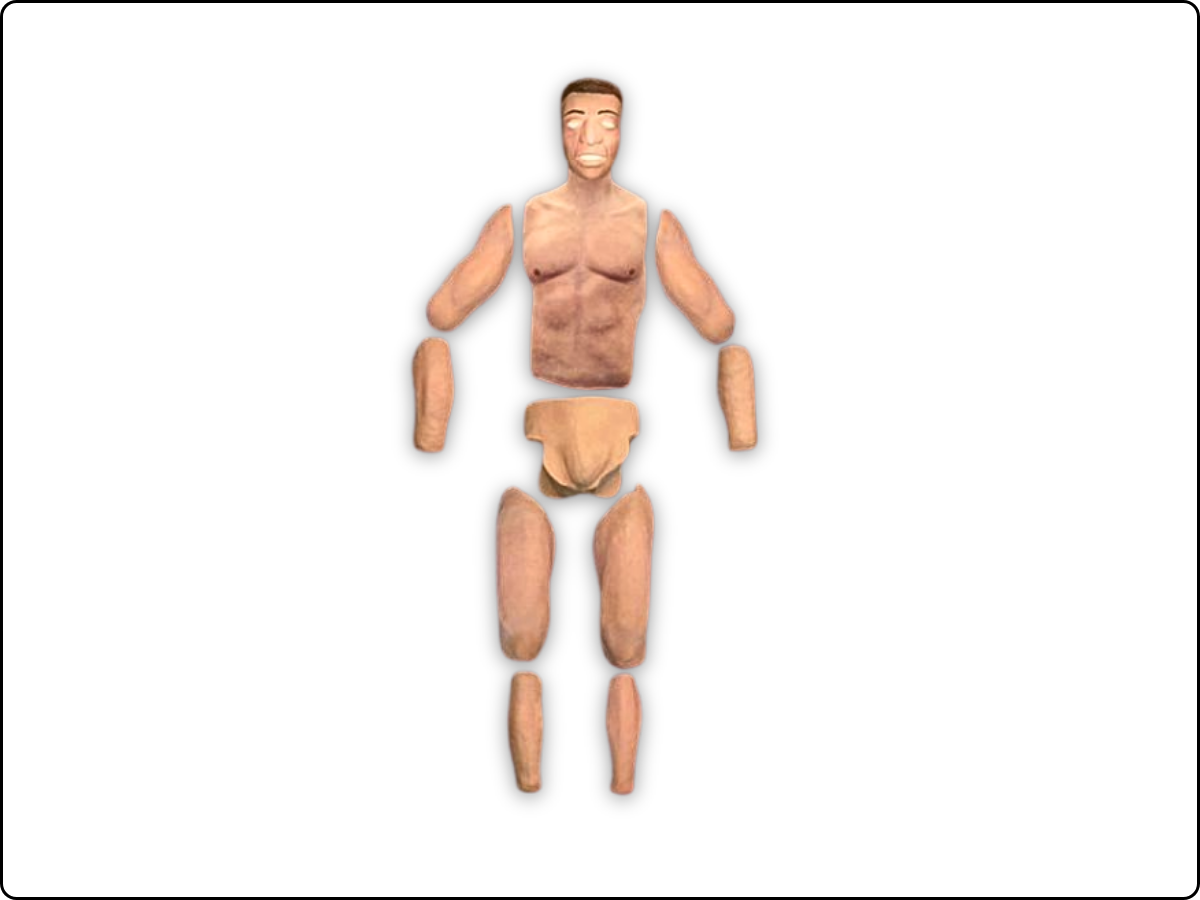
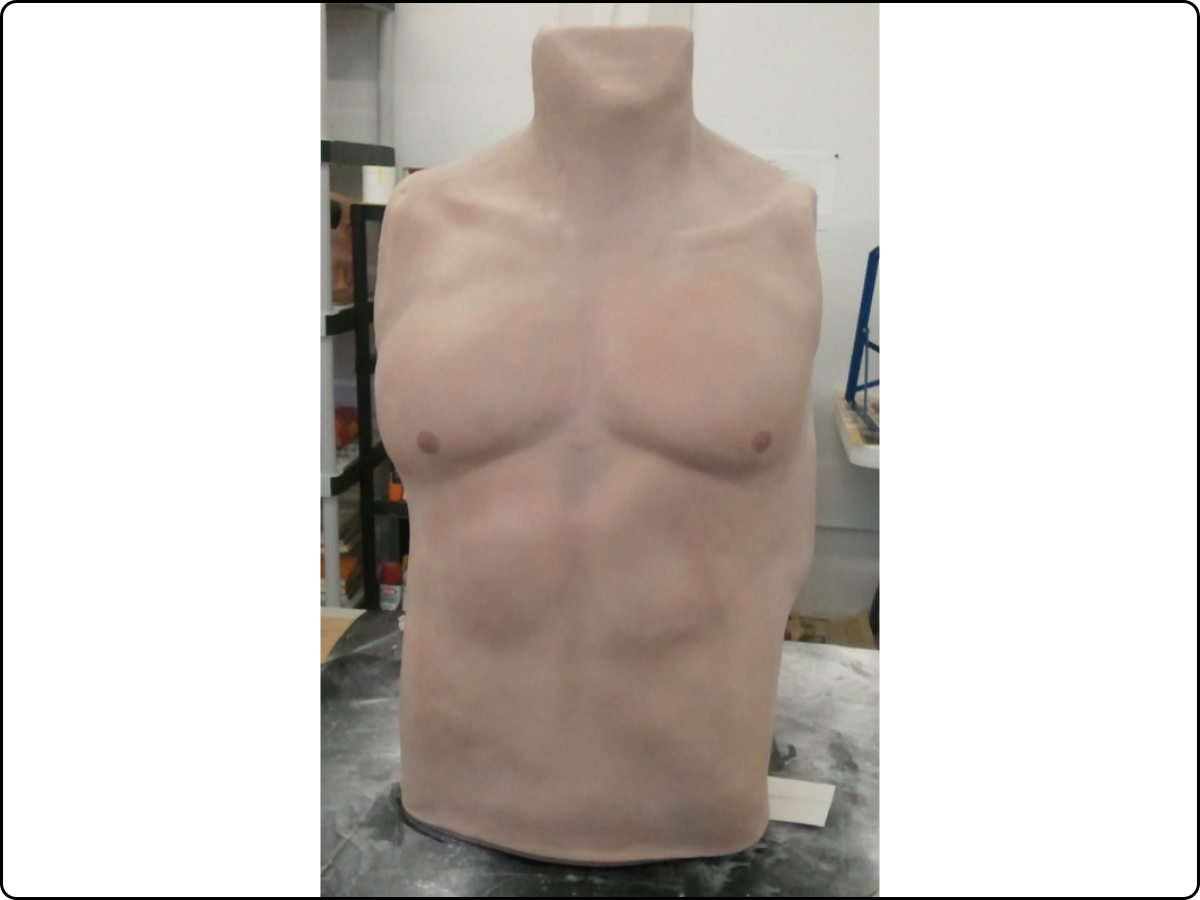
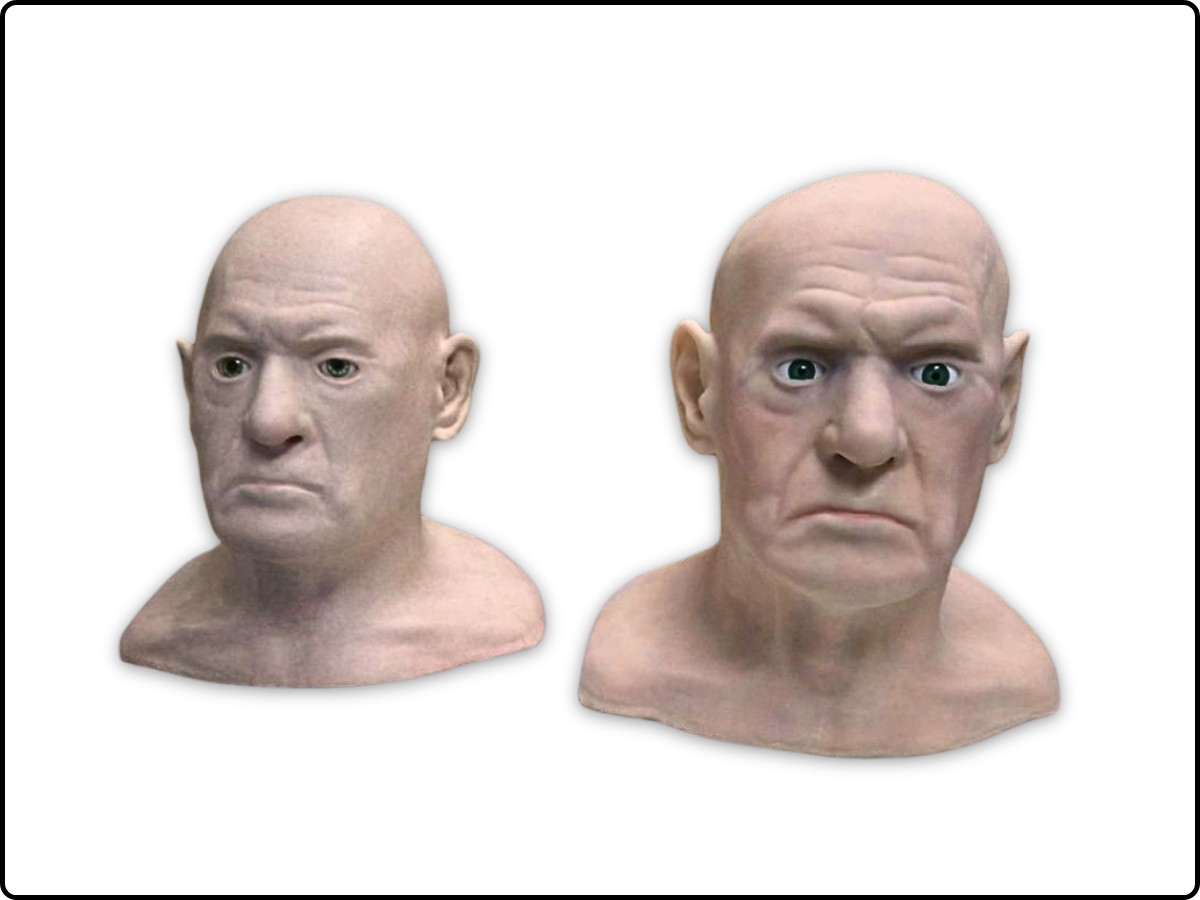
Then there was the military skin suit we partnered with other companies on to successfully win a government contract. It was a full-body silicone suit for a sensor-embedded mannequin that had to survive desert field testing. I designed anatomically correct skin sleeves for every segment of the body, a functional mask that moved with the robotic face underneath it, and got the whole thing production-ready. The government tested it in the field. It held up. We won the contract.
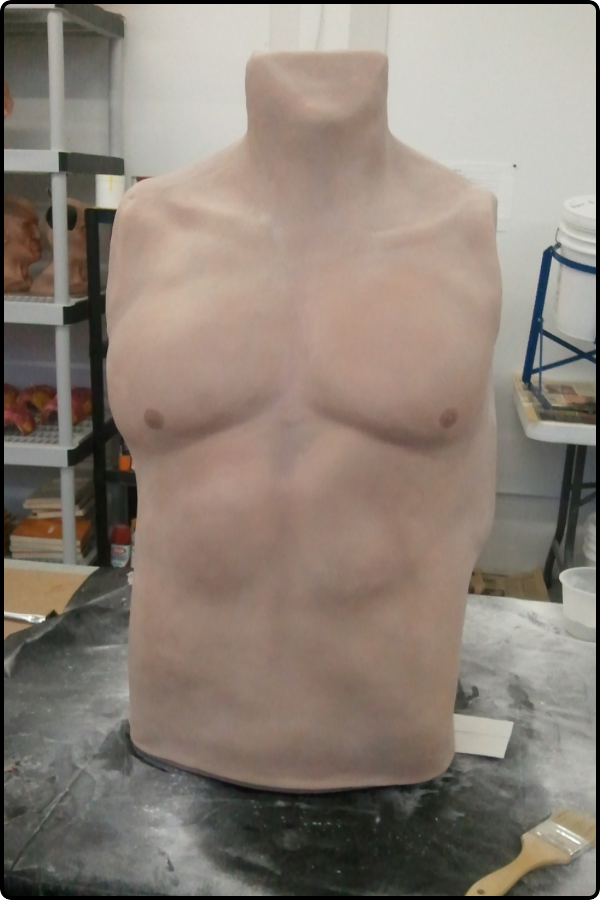
Military skin suit torso detail
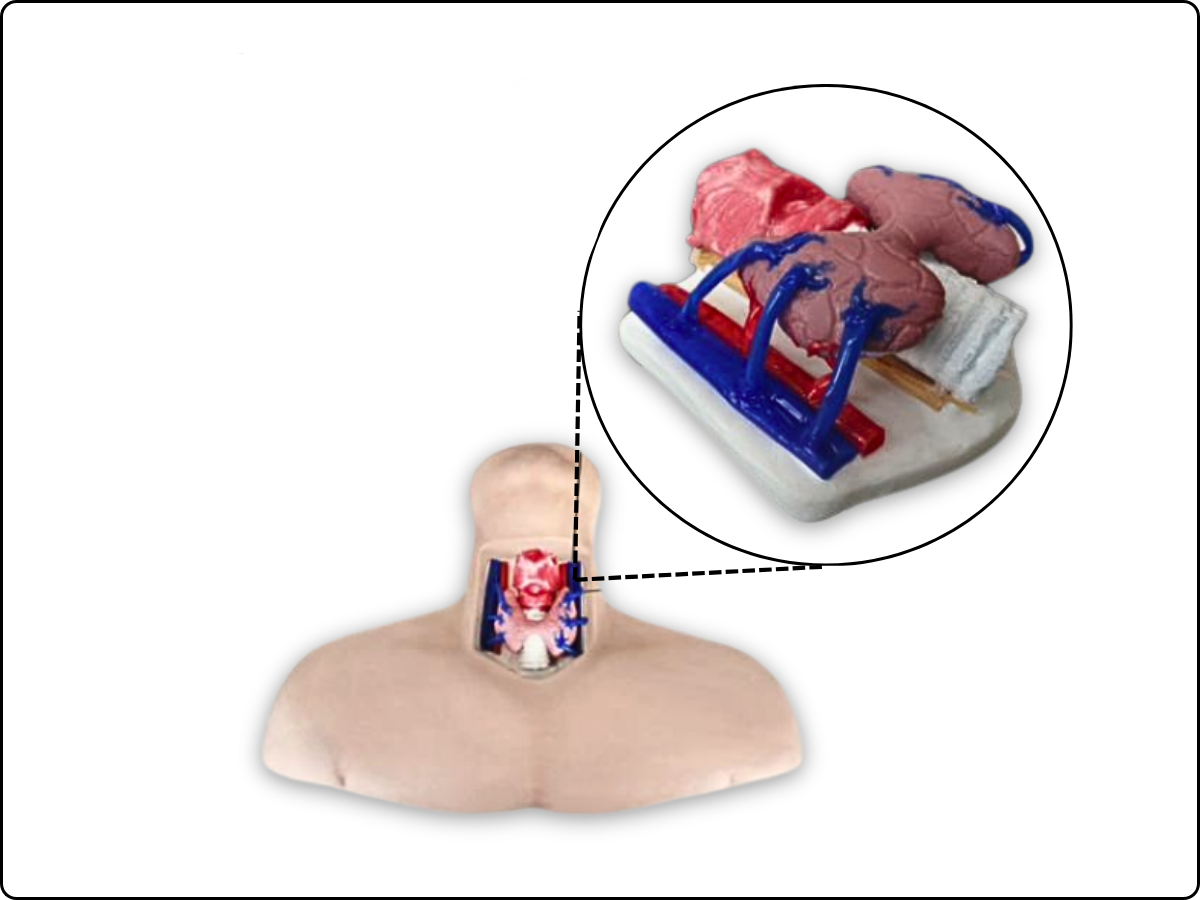
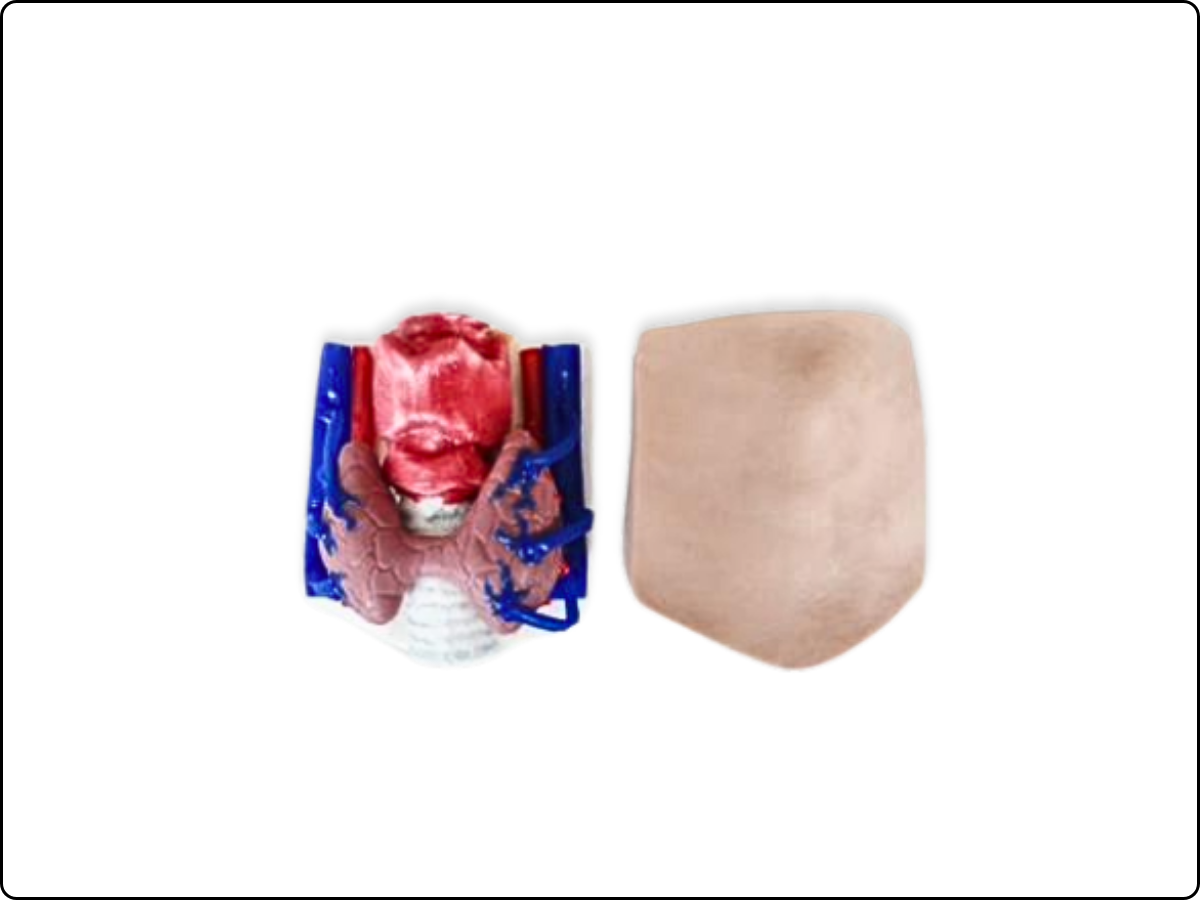
The Thyroidectomy Trainer came from a collaboration with a physician: a fully modular anatomical trainer with replaceable internal components so the full procedure could be practiced without replacing the entire model after each use. I'm listed as co-inventor on the U.S. patent, having fully designed the model and its manufacturing procedure.
U.S. Patent — Co-Inventor
A modular, anatomically detailed training device for practicing the full thyroidectomy procedure. Designed in collaboration with a physician. Replaceable internal components extend lifespan and reduce cost.
As the company grew, we partnered with a manufacturer in China to handle production at scale. I was the one they sent over. I spent a little over a month on-site, training 27 engineers on our manufacturing processes and getting production running. I had a translator who assisted during training, but my trips to the grocery store were always interesting to say the least.
As someone who started as a model maker a few years earlier, I loved the personal growth I was making and was proud of what I had accomplished.
The company began scaling back US based operations after the China OEM and for years I had a question I would be asked time and time again by customers: Is it reusable? I wanted to make reusable products and not only give the customers what they wanted, but also lessen the environmental impact of our company. At that time, after using the product once, it was trashed and sent to the landfill. The investors and stakeholders prioritized consumerism and profit more than what aligned with my values as I continued to become a young adult and recognize what I felt was important. So I made the decision to start my own simulation company built around environmentally aware manufacturing, product designs, and packaging. I developed a process to grind down used silicone products, blend the resulting pellets back into fresh material, and recast them into new models. The recycled material turned out to be more realistic than the original. That was a side benefit I hadn't expected, and one that proved the instinct right.
With my new company, Tall Tree, I also introduced 3D printing into my design process. A tool that saved me countless hours of labor spent on hand carving designs from clay. I was able to use my 3D modeling knowledge gained in high school and college as a foundation to continue improving and create the models on my computer before sending over to the printer.
I also recognized the value injection molding could provide to my products and after proper research, I secured a CNC router capable of carving molds from aluminum. In addition to the router, I added a plastic injection machine to my workshop. The beauty of this plastic injector was its ability to melt plastic bottles and use them for our products. It aligned perfectly with my company's purpose of being environmentally aware.
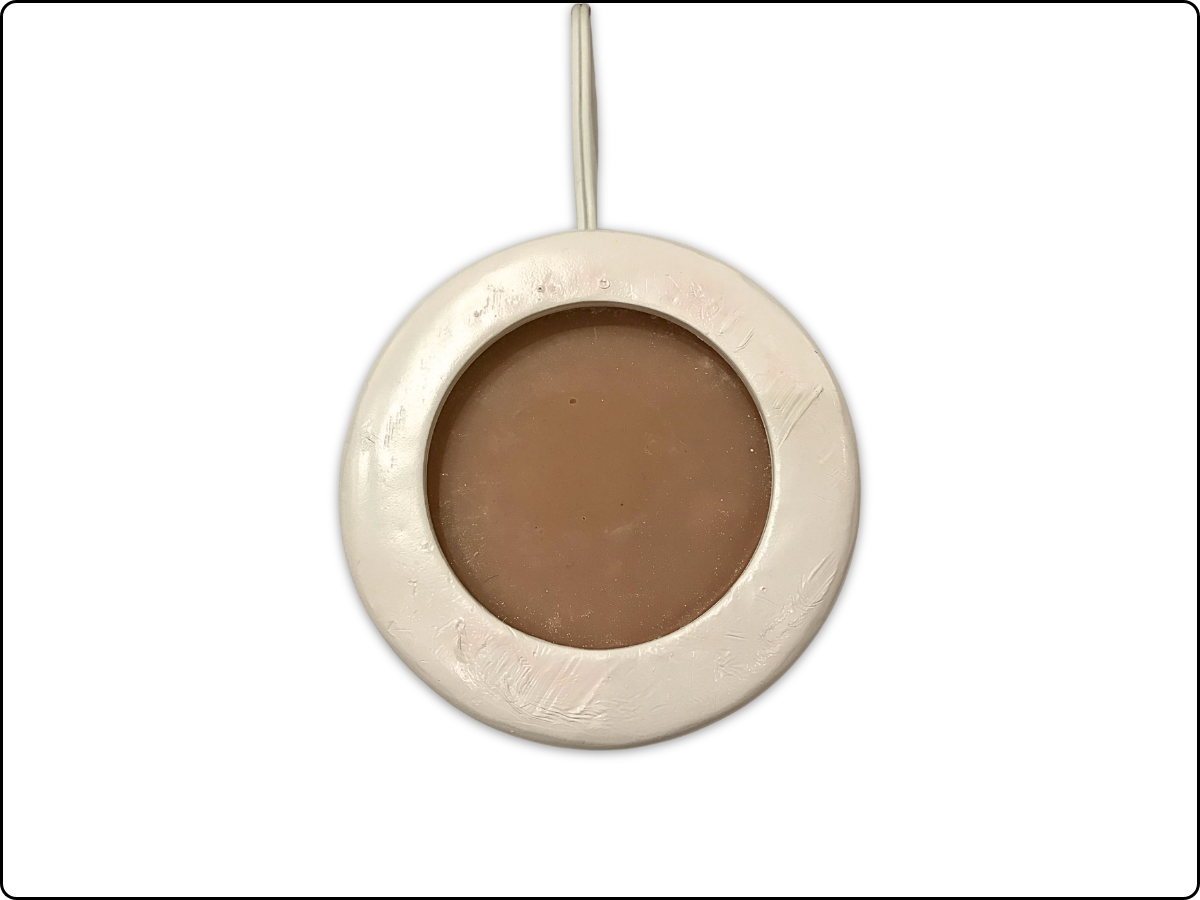
Going into its third year, Tall Tree was gaining traction fast. My products were reusable or recyclable and creative. A prototype for the first "self healing" skin pad had just been created and I was testing consumer interest by attending conventions and running demonstrations with it. It was a clever, yet simple design, consisting of a thermoplastic elastomer with a heating element built into its base. Make an incision and practice suturing, turn on the heating element for 5 minutes and watch it heal, then turn it off and let it cool. Unfortunately, a prototype is as far as this design progressed, as well as Tall Tree as a whole, because in early spring of that year is when the COVID pandemic began. Without teaching workshops or demonstrations being performed, there was no longer a need for my products and I had to move on from Tall Tree and the exciting potential it had.
Tall Tree
A self-founded medical simulation company built around environmentally aware manufacturing. Recyclable materials, 3D-printed molds, CNC-carved aluminum tooling, and a plastic injection process that used melted plastic bottles as raw material.
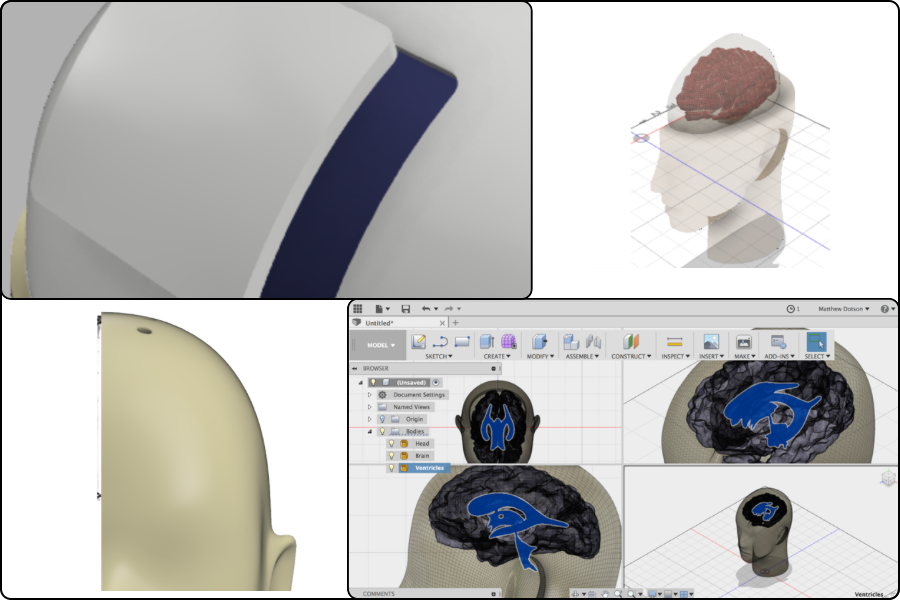
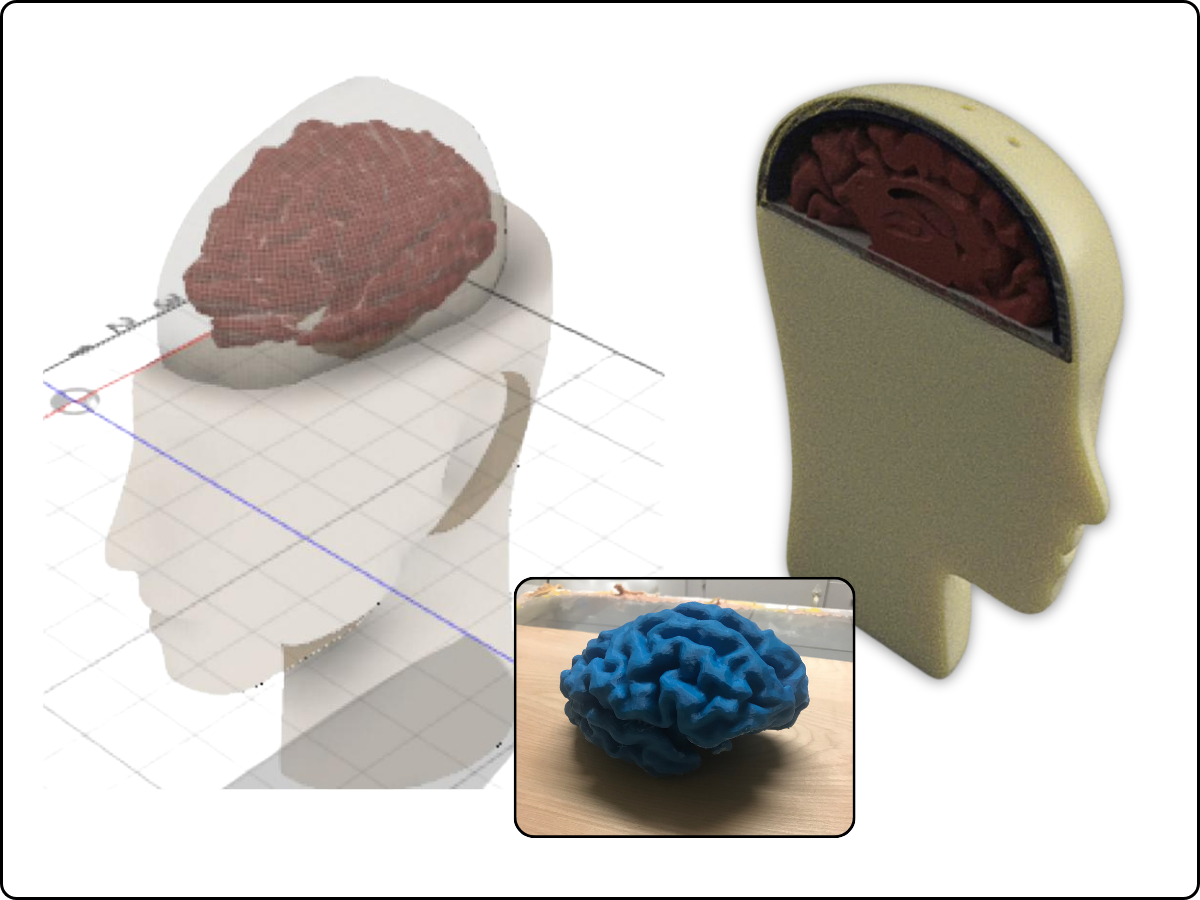
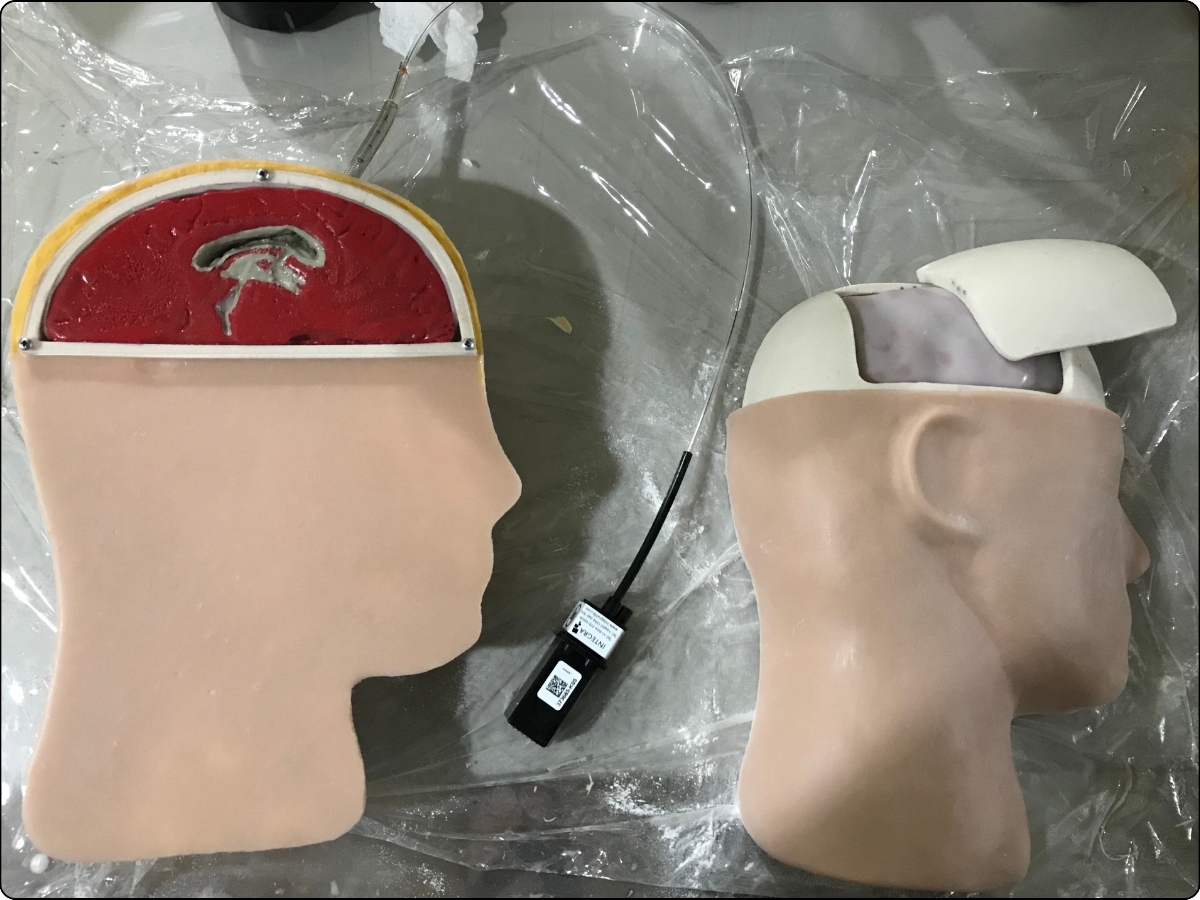
Brain catheter simulation model
Work Samples
Selected projects from the medical simulation years. Click any card to see more detail and photos.
Ethicon Suture Pad
Translucent training pad with embedded client branding. Became the company's best-selling product and led to its largest contract.
View details ↗
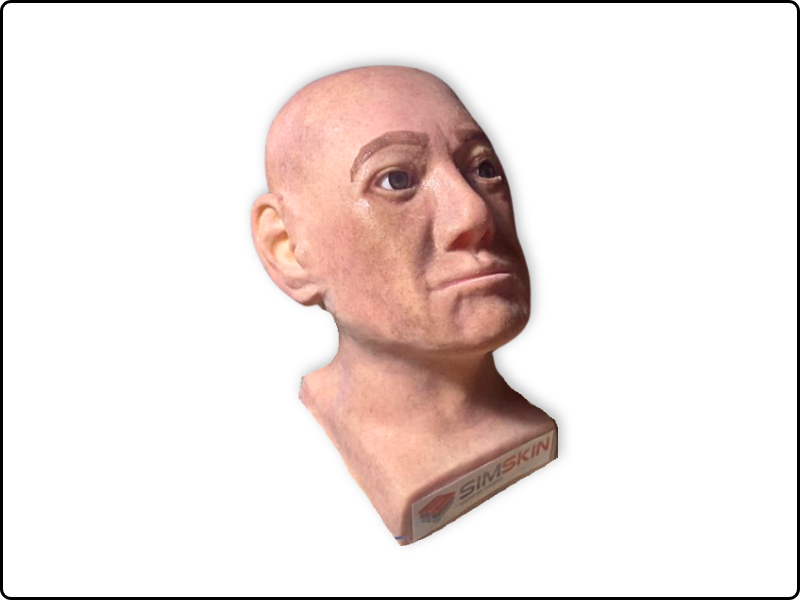
Cosmo Head Model
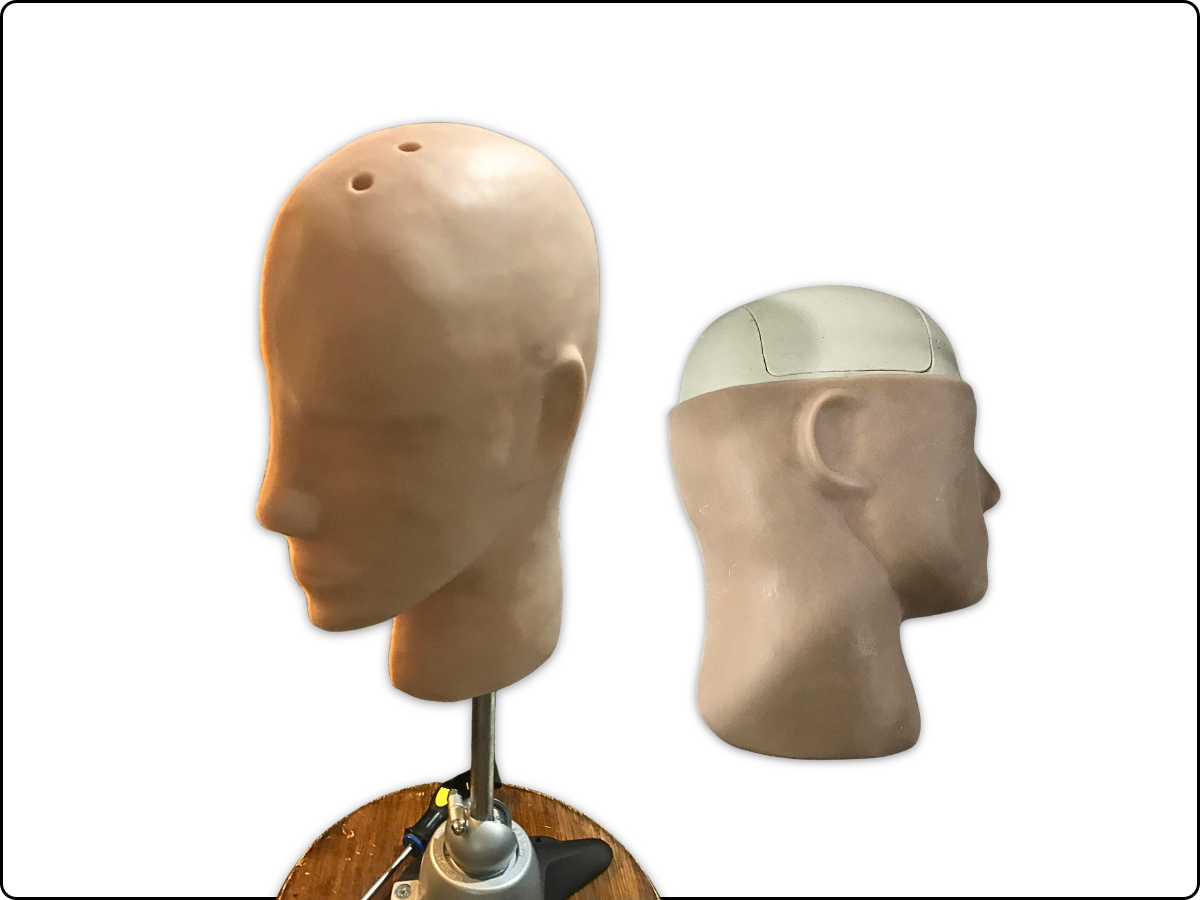
High-fidelity head model for suturing and injection practice. Liftable skin layer, ear suture capability, realistic skin tension.
View details ↗
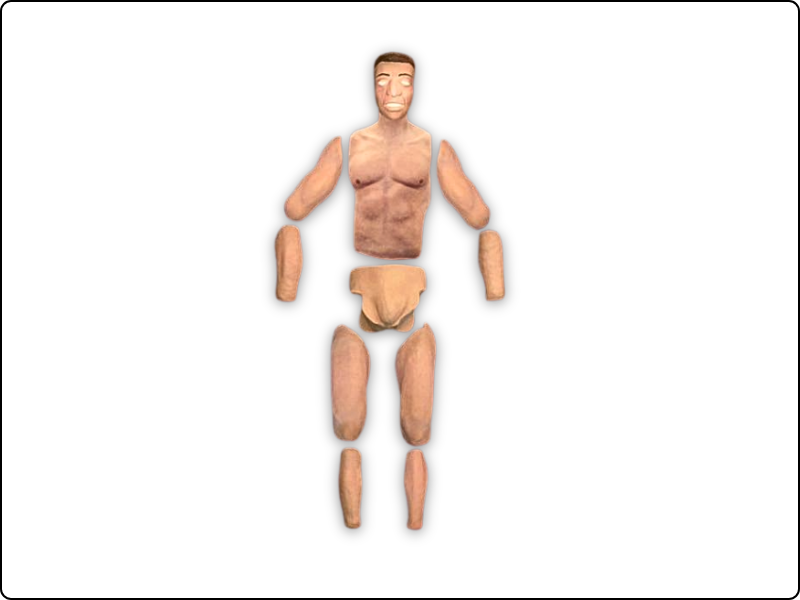
Military Skin Suit
Full-body silicone suit for a sensor-embedded military mannequin. Designed to survive desert field testing. Government contract awarded.
View details ↗
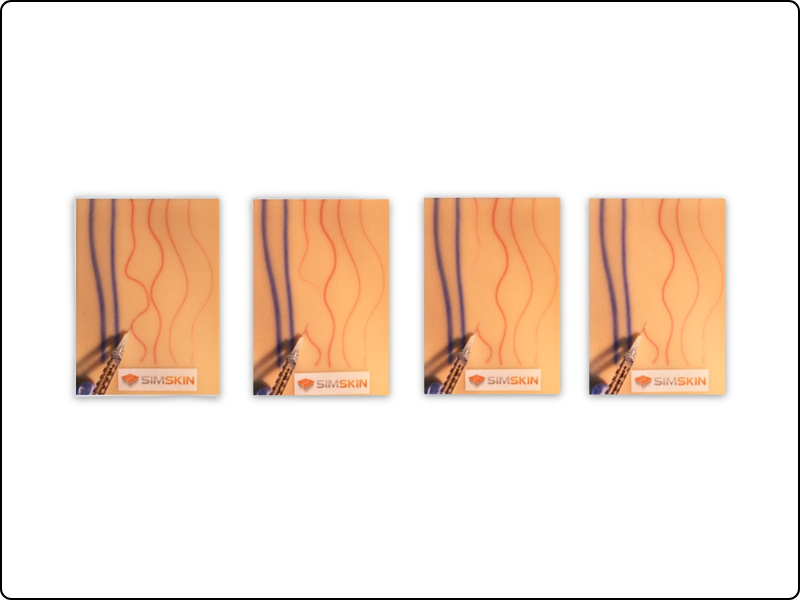
Sclerotherapy Pad
First-of-its-kind thermochromic training pad. Vessels visually disappear on injection. Fully reusable.
View details ↗
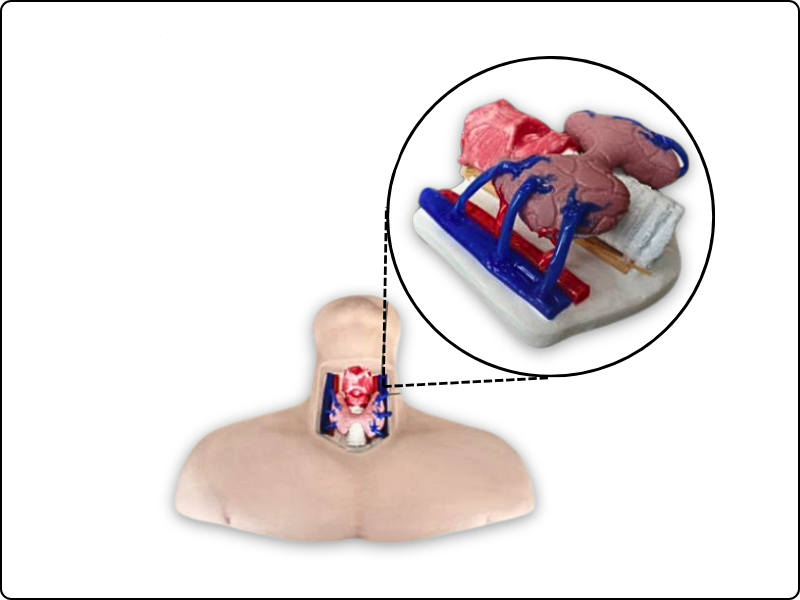
Thyroidectomy Trainer
Modular anatomical trainer for full thyroidectomy simulation. Replaceable internal components. Co-inventor on U.S. patent.
View details ↗
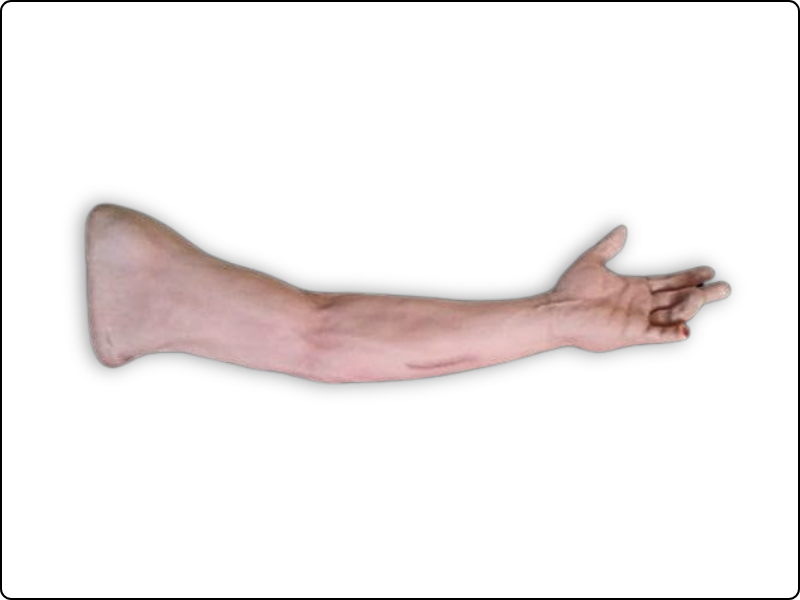
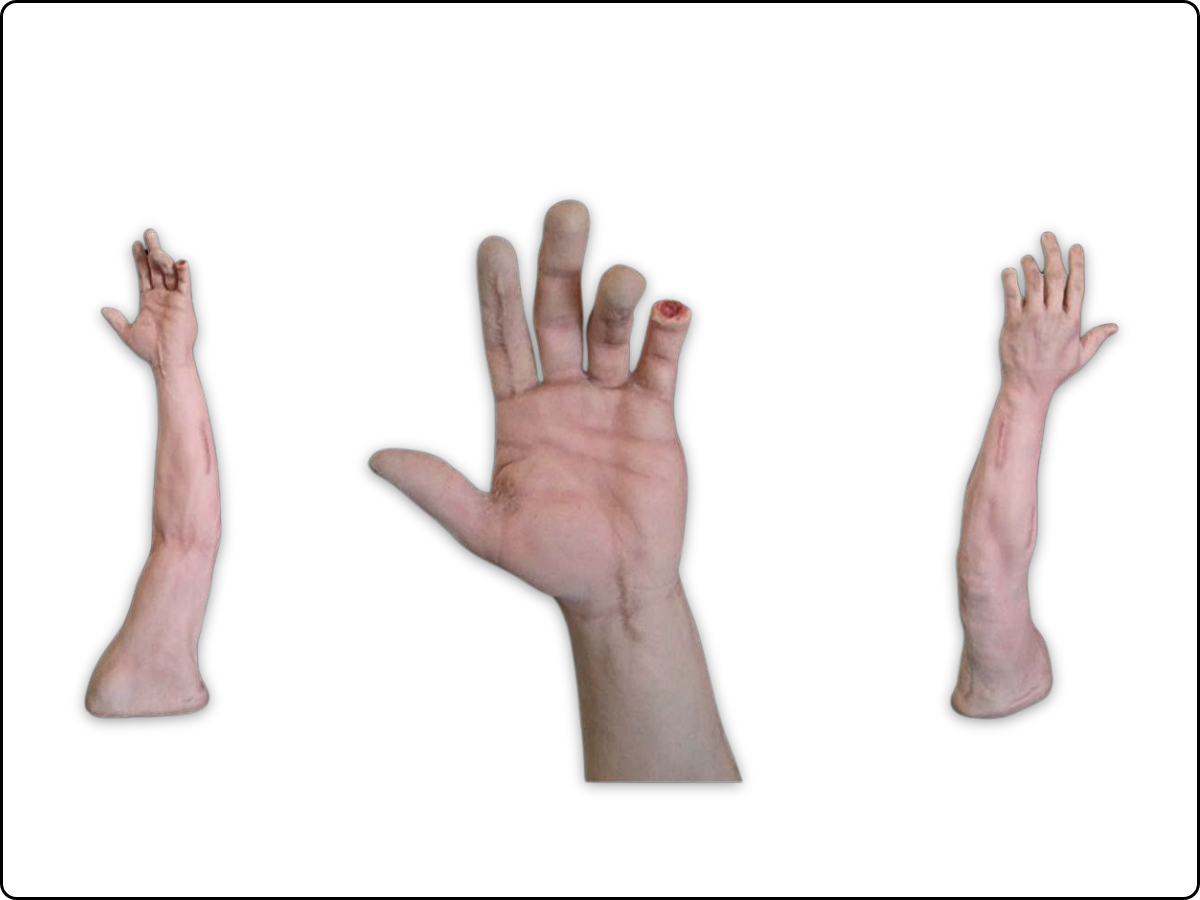
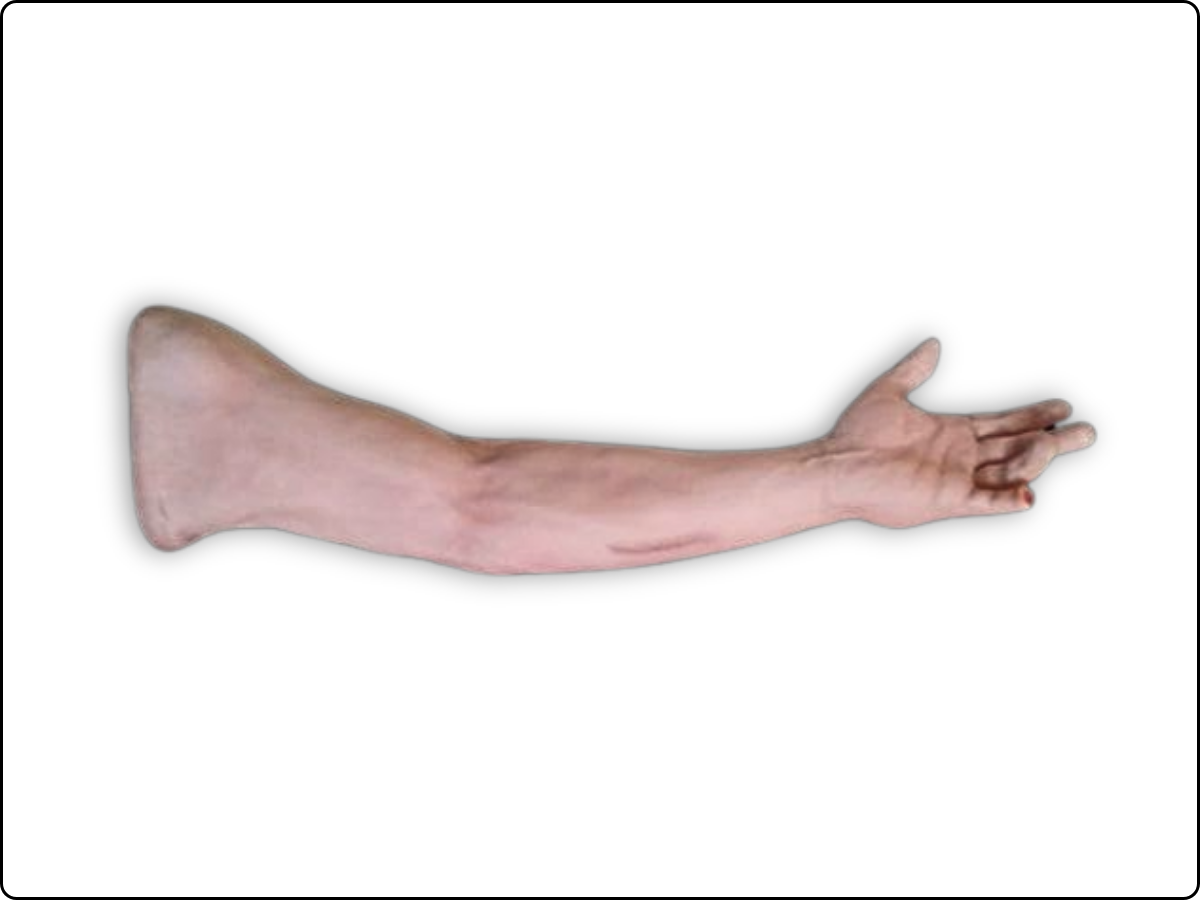
Scar Revision Arm
Realistic arm trainer for military scar revision practice. Cast from my own arm. Deployed with the Navy.
View details ↗
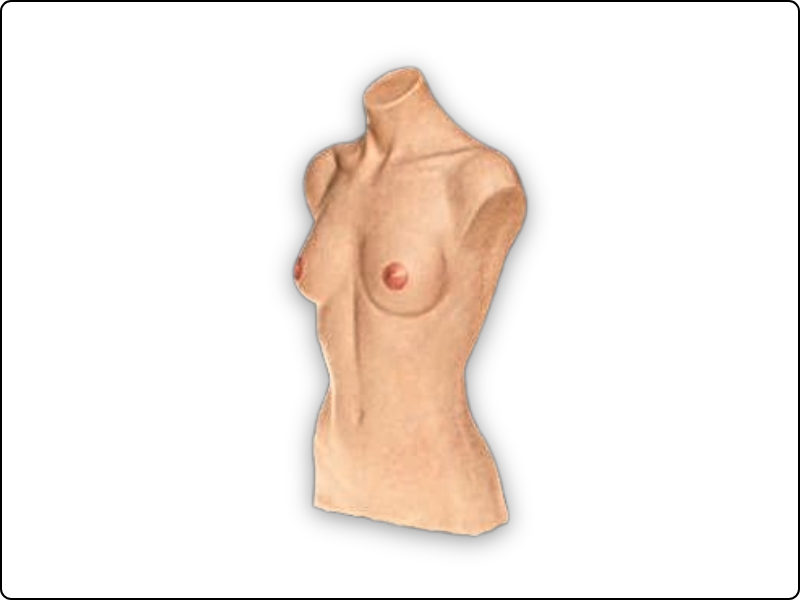
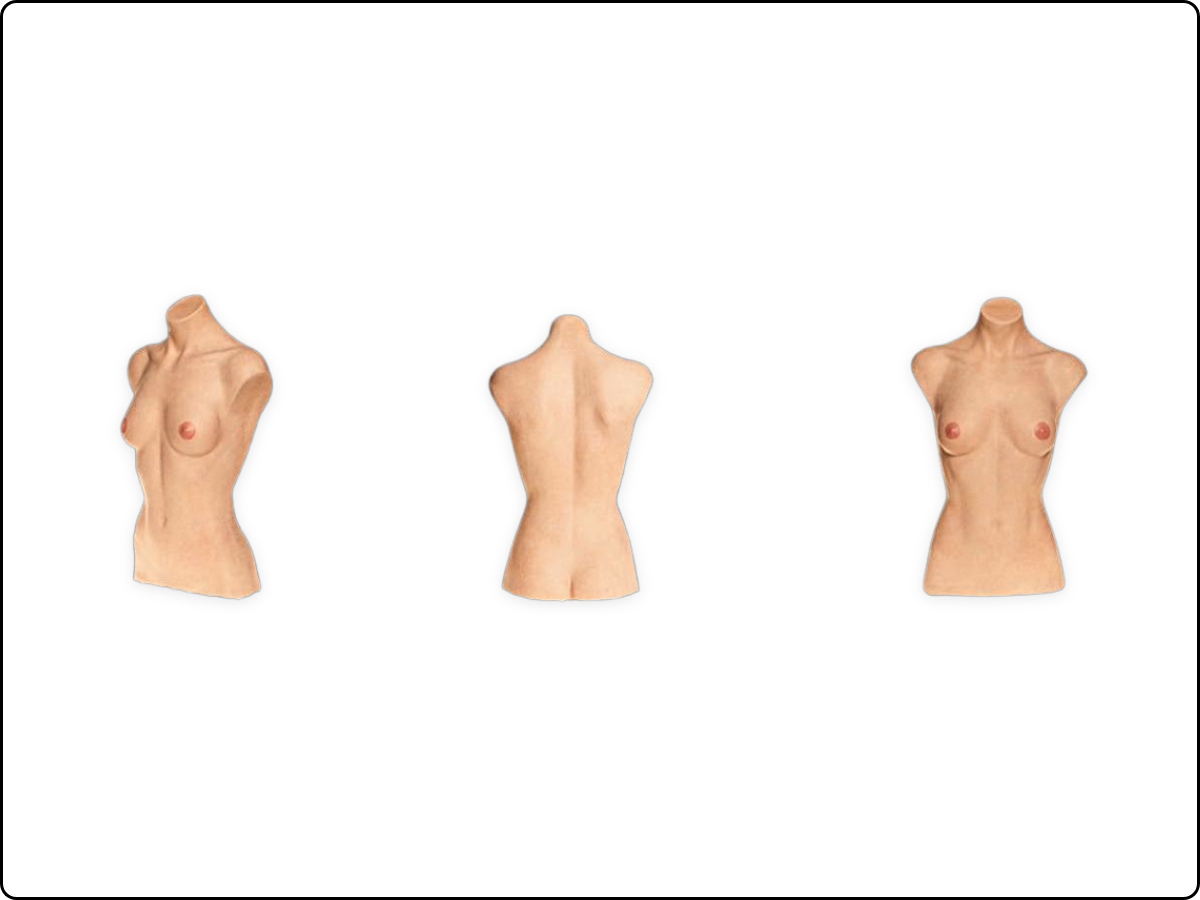
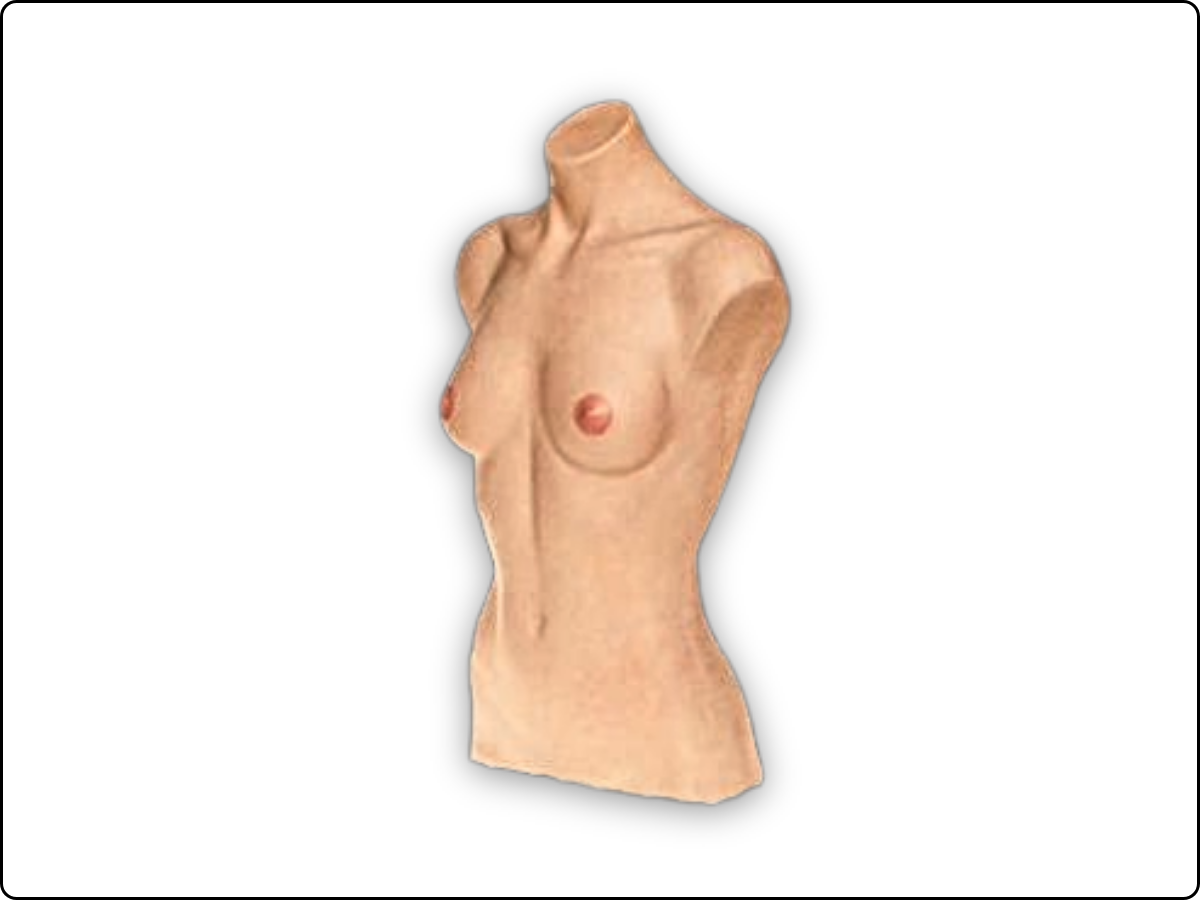
Female Torso Model
Breast augmentation plotting trainer with realistic skin pushback resistance for accurate pre-operative marking practice.
View details ↗
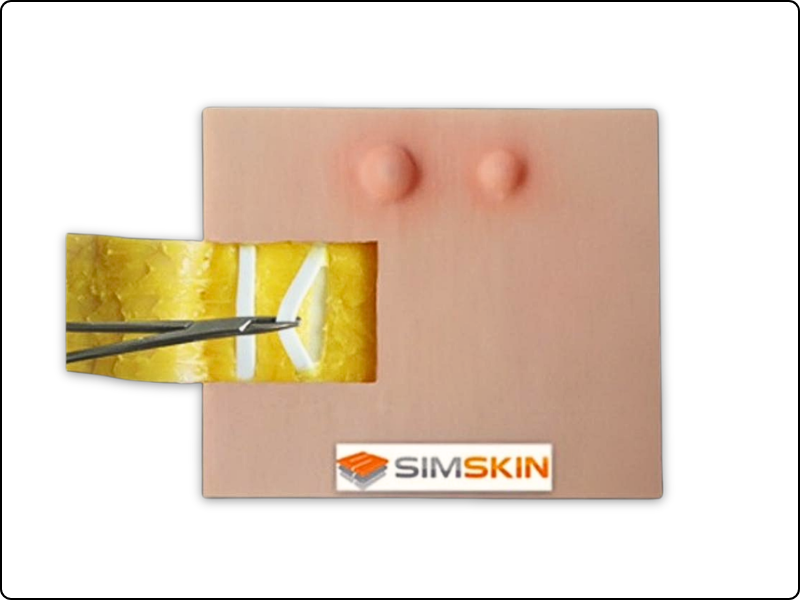
Nurse Training Pad
Multi-function pad for tendon inspection and abscess drainage practice. Hand-painted abscess chambers beneath layered skin.
View details ↗
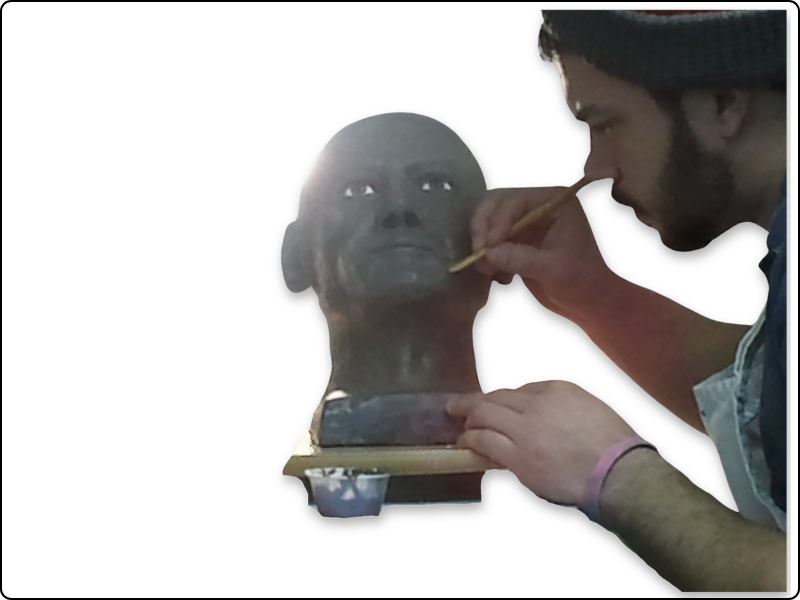
Process Improvements
Systematic redesign of manufacturing processes. Lighter materials, improved molds, faster production, better fidelity.
View details ↗
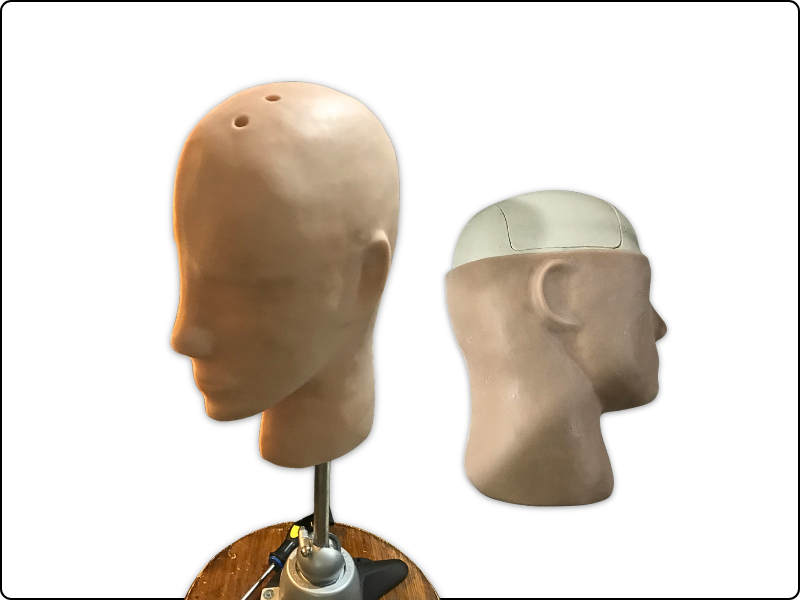
Brain Catheter Model
3D-designed anatomical trainer for neurovascular catheter simulation.
View details ↗
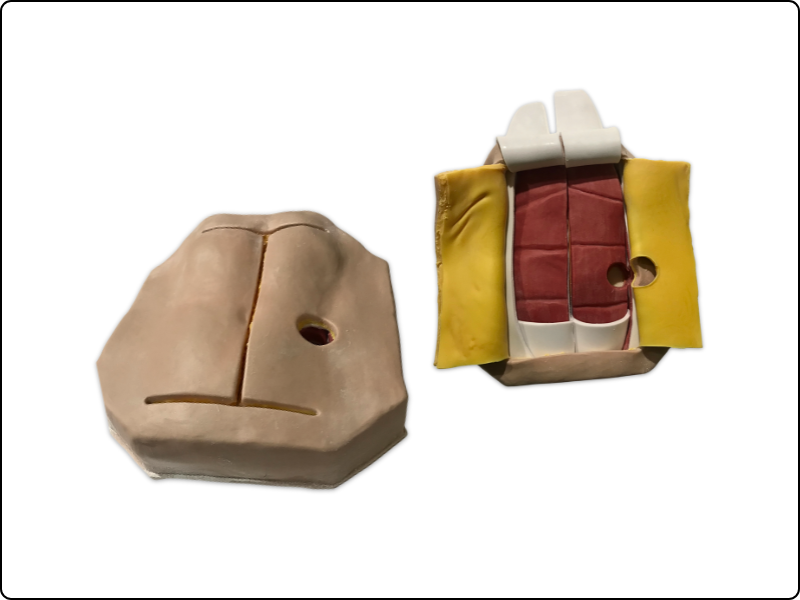
Abdominal Mesh Model
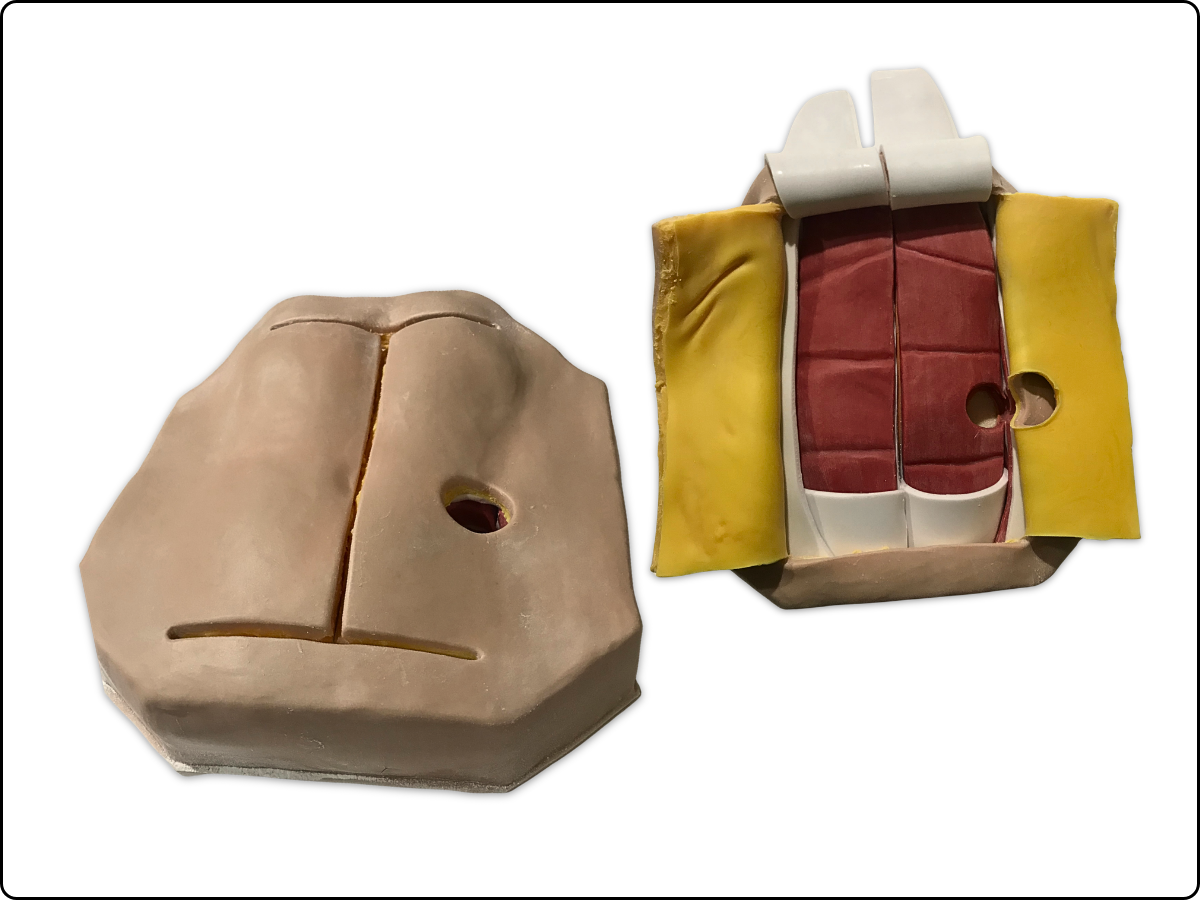
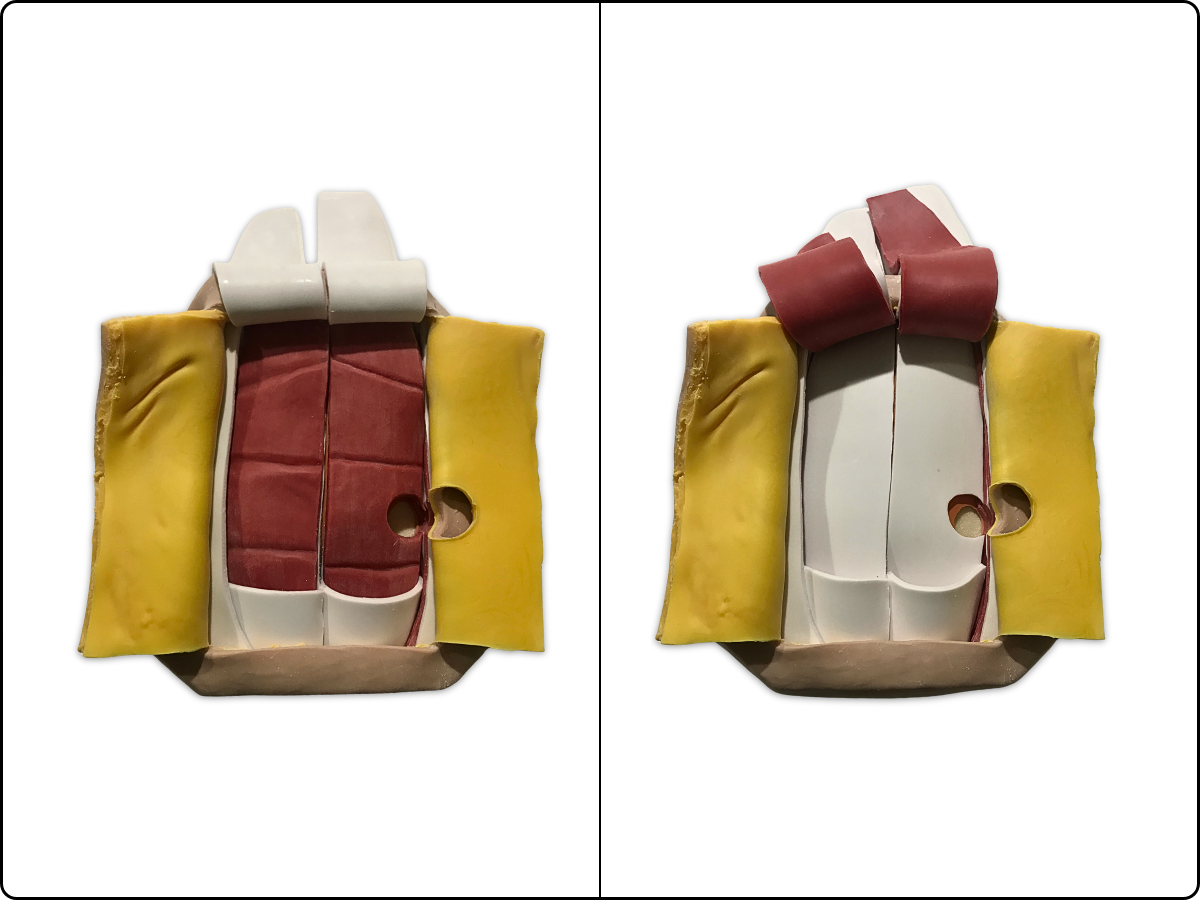
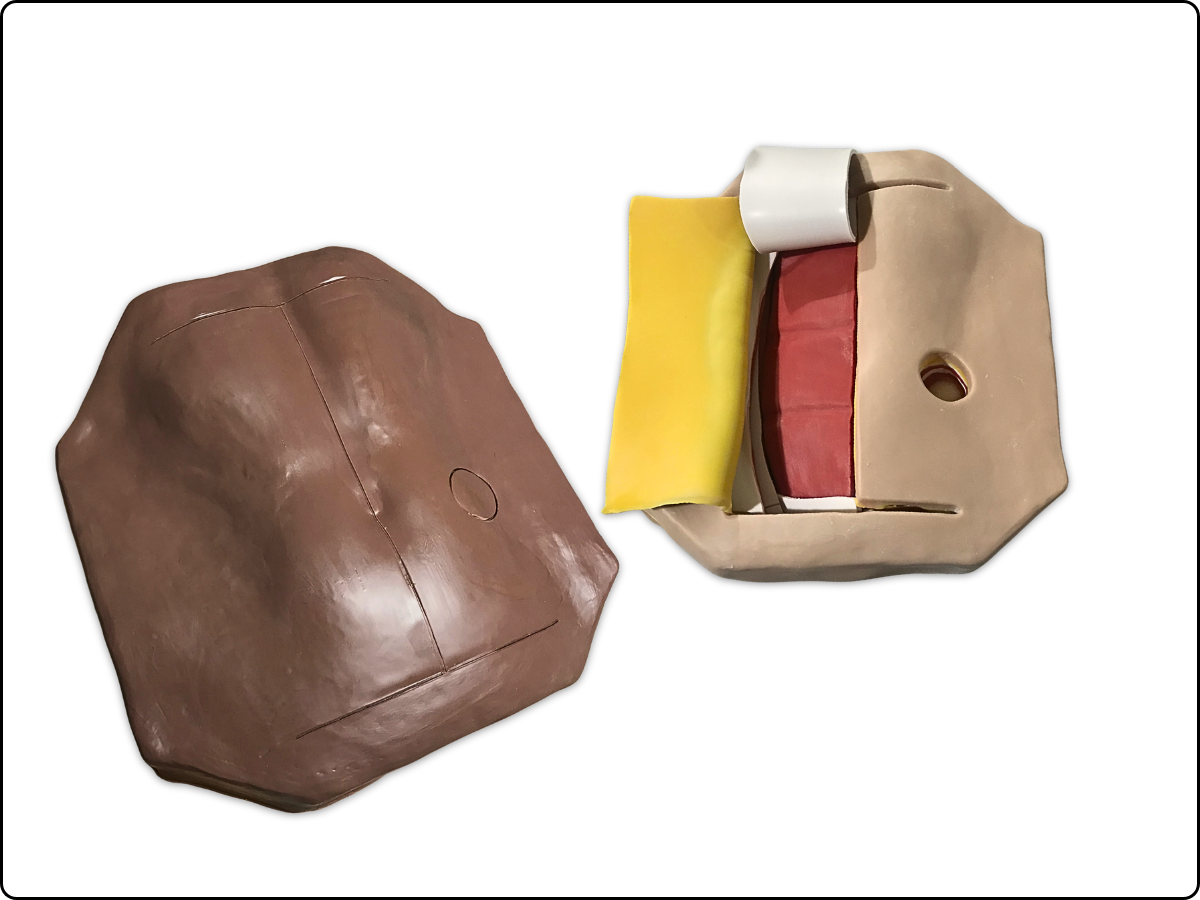
Multi-layer abdominal trainer for mesh application. Skin, fat, fascia, muscle, and a simulated colostomy.
View details ↗
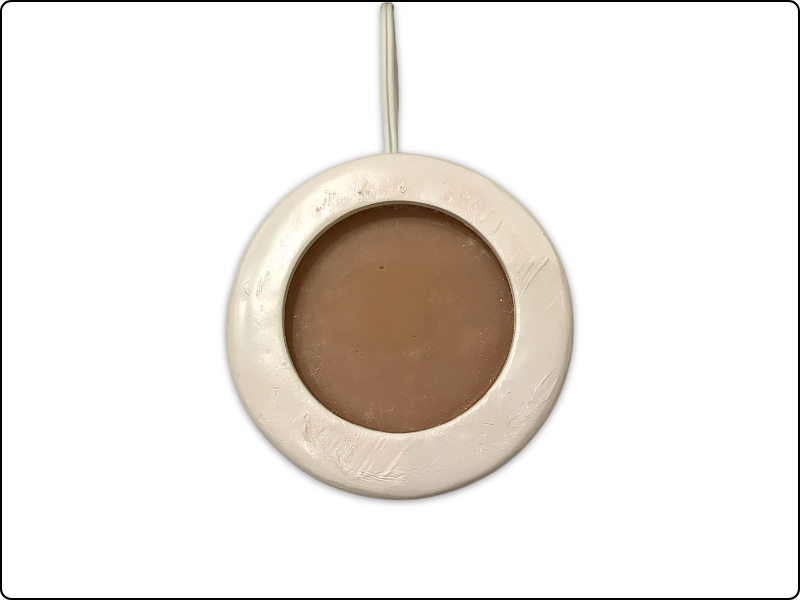
Self-Healing Skin Pad
Prototype suture pad with thermally self-healing silicone. The concept that started it all.
View details ↗
Ethicon Suture Pad
Ethicon wanted a custom skin pad their sales reps could carry to demonstrations. I designed a translucent pad with layered dermis and subcutaneous anatomy, and their logo embedded underneath the skin layer, visible through the material. This allowed the rep to show how the suture operated while under the skin. It became the largest contract the company had landed to that point.
Cosmo Head Model
High-fidelity silicone head model for suturing and injection training. Features a liftable skin layer that allows practitioners to see suture placement beneath the surface, ear suture capability, and realistic skin tension that mimics live tissue. Top-selling model in the catalog.
Military Skin Suit
Full-body silicone suit for a sensor-embedded military mannequin that had to survive desert field testing. I designed anatomically correct skin sleeves for every segment of the body, a functional mask that moved with the robotic face underneath it, and got the whole thing production-ready. The government tested it in the field. It held up. We won the contract.
Sclerotherapy Pad
The founder handed this to me unsolved. The procedure involves injecting a sclerosing agent into varicose veins, causing them to collapse and disappear. Simulating that visually had stumped everyone. I mixed thermochromic pigments into silicone and made hollow vessels. When you injected warm liquid, the vessels appeared to vanish, exactly like the real procedure. Fully reusable: cool it down and it reset completely. Nothing else on the market did what it did.
Thyroidectomy Trainer
Fully modular anatomical trainer designed in collaboration with a physician. Replaceable internal components allow the full thyroidectomy procedure to be practiced without replacing the entire model after each use. I am listed as co-inventor on the U.S. patent.
Scar Revision Arm
Realistic arm trainer for military scar revision practice. Cast from my own arm using silicone molding techniques developed in-house. Designed to simulate the tissue resistance and visual characteristics needed for accurate scar revision training. Deployed with the Navy.
Female Torso Model
Training model for breast augmentation plotting practice. Features realistic skin pushback resistance that mimics live tissue, allowing surgeons to practice pre-operative marking with accurate tactile feedback.
Nurse Training Pad
Multi-function training pad for tendon inspection and abscess incision and drainage practice. Features a simulated tendon beneath layered skin with hand-painted abscess chambers that provide realistic visual and tactile training for nursing procedures.
Process Improvements
Systematic redesign of manufacturing processes across multiple product lines. Identified inefficiencies in material usage, mold design, and production flow. Developed lighter material formulations that maintained or improved fidelity, redesigned mold systems to reduce cycle time, and documented new processes for team-wide implementation.
Brain Catheter Model
A 3D-designed anatomical trainer for neurovascular catheter simulation. Detailed internal vascular anatomy reproduced for accurate catheter navigation and placement practice.
Abdominal Mesh Model
Multi-layer abdominal trainer built for mesh application practice. Layered anatomy — skin, fat, fascia, and muscle — with a simulated colostomy for realistic procedural training and mesh placement.
Self-Healing Skin Pad
A prototype suture pad built around a thermoplastic elastomer with a heating element in the base. Make an incision and practice suturing, then run the heating element for a few minutes to watch it close back up, then let it cool. This was the concept Tall Tree was building toward before the pandemic cut it short.
2022 – Present
Industrial manufacturing was new territory. My background before this had been small-scale and highly specialized: medical simulation components, OEM setups, a small-batch silicone recycling operation. Nothing at this kind of volume or pace. It proved difficult to show how my skills could extend beyond a niche field like medical simulation, but there were still bills to pay and support I needed to provide my children.
This takes us to my current employer and within eight months I'd reached Level 3 machine operator. I credit this promotion to my constant curiosity and ability to understand a process, even if it's new to me. By paying attention, picking things up quickly, and caring about doing the job right with pride, people began to notice. I have built strong and positive relationships because of the effort I make in everything I do and the compassion I have for others. It's important to me to support and lift those around me in a positive way, because a rising tide tends to lift all boats.
A self driven initiative that seemed to really help my credibility was my creation of a manufacturing process app. My department had no centralized way to digitally track manufacturing orders while being processed, product specs, fault codes, completion status, or shift data in real time. This is in addition to many other metrics that would immediately save time and production costs and also long term costs by tracking key trends over time. I designed and built a solution on my own time: a single-file HTML, CSS, and JavaScript production management app, optimized for mobile use on the factory floor. No assignment, no request. I saw the gap, understood it, and built something that addressed it. Granted, this was with the help of AI and some clever vibe coding, but the app was good. Really good, and has been sent to the proper department for further evaluation and how it can be implemented. Although, since I submitted it, I have noticed similar software and web apps have been created for different departments across the company. I'm glad that if my app did anything, it may have sparked improvements across the company.
Recognize a need, understand why and how it's needed, and build something that performs.
Under Company Review
Built a process management app on my own initiative. I saw room for improvement, identified friction points, and developed a solution. Currently under company review for implementation.
2022 – Present
This didn't start as a career move. I was managing a lot and needed leverage, ways to get more done within the same amount of time. Enter the world of automation and iOS shortcuts. I had just created an online brand and e-commerce site as a side project, and automating the site saved me several hours on a weekly basis. It was right around this time that ChatGPT's voice model had just been released and AI tools started becoming genuinely capable. I went deep and stayed there. I've used different models every single day for almost the past 3 years and have witnessed the daily evolution of these models without blinking.
Make.com and Zapier were my primary workflow automation tools when I began and mostly still are. They assist in complex agentic workflows, especially when I want to isolate nodes and agents. Since I started pursuing my passion for AI, I've worked directly with calling models via APIs, hosted models locally, made my own protocols, and built custom interfaces when the right one doesn't exist. I've worked across ChatGPT, Gemini, Claude, Perplexity, Qwen, and many others. I've built with image generation models, open-source hardware configurations, and self-hosted infrastructure including a VPS setup with SSL, Nginx as a reverse proxy, and hardened security settings.
The projects I've built include a multi-platform streaming dashboard with live message translation, a personal productivity system with session-aware scheduling, a decision making protocol I call Fortune Cookie, and a semi-automated job search pipeline backed by a structured database with resume tailoring. Most of these started because I needed them. All of them taught me something I couldn't have gotten any other way.
Years of daily engagement with AI has given me a depth of understanding most people don't have yet. I know how these systems think. I've applied that thinking to protocols, to how information structures itself, to the way problems can be reframed through an AI lens. I've strived to be fluent in the language of AI. First recognizing and understanding how humans often make decisions and process information, I then apply that same method to a system process.
The world is shifting around this technology, and I'm glad to have such a passionate understanding and curiosity for it. I'm looking for work where that fluency is valued, and I can continue to follow my curiosity.
Software & Skills
A working inventory of the tools and skills I use. Click any software card for detail on how I use it.
Make.com
AdvancedPrimary automation platform. Multi-step workflows connecting forms, APIs, email, Airtable, and Google services.
Claude
ExpertDaily driver for writing, reasoning, and code. Used to build and iterate on this site. Preferred for nuanced, long-horizon tasks.
ChatGPT
AdvancedDaily use for brainstorming, summarization, and rapid ideation. Integral to my workflows for nearly two years.
Microsoft 365
AdvancedWord, Excel, PowerPoint, and Teams for professional documentation, analysis, and communication.
Shopify
AdvancedSet up and managed e-commerce end to end. Product listings, payment flows, and order management.
Zapier
ProficientLightweight automations and trigger-based workflows where speed of setup matters most.
Airtable
ProficientData layer for automation pipelines. Forms, views, and API connections. Powers the peer review system on this site.
Gemini
ProficientMultimodal tasks and Google Workspace integrations. Strong for research requiring current data.
Perplexity
ProficientGo-to for fast, cited research. Useful for verifying information quickly without rabbit holes.
HTML / CSS / JavaScript
ProficientBuilt this entire site by hand. Comfortable with layouts, animations, responsive design, and API integrations.
After Effects
ProficientMotion graphics and animation for creative projects and visual storytelling.
Photoshop
ProficientImage editing, compositing, and asset creation for web and creative work.
Canva
ProficientQuick design work, social assets, and presentation materials. Strong for rapid turnaround creative.
Google Workspace
ProficientDocs, Sheets, Drive, and Gmail woven into automation workflows. Daily productivity suite.
Notion
ProficientKnowledge management, documentation, and structured data embedding.
Jotform
IntermediateIntake forms and client-facing data collection connected to Make.com for downstream automation.
GitHub
IntermediateVersion control and repository management for web and automation projects.
Fusion 360
Intermediate3D modeling for product design and prototyping. Used extensively during medical simulation R&D.
Asana
IntermediateProject and task management for tracking multi-step workflows and initiatives.
Slack
IntermediateTeam communication and notification routing inside automation pipelines.
Firebase
IntermediateBackend-as-a-service for web app data storage and real-time database integration.
Hostinger
IntermediateWeb hosting and VPS management. Runs this site plus self-hosted infrastructure with SSL and Nginx.
Zoom
IntermediateVideo conferencing and remote collaboration, including demo and webinar sessions.
OpenClaw
ProficientOpen-source personal AI agent running on my own hardware, connected to LLMs. Deploying on Hostinger VPS.
What's Next
Remote or hybrid roles in AI, automation, or operations, where the work is about solving real problems and building things that last. If that sounds like your team, I'd like to talk.